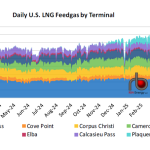
U.S. LNG exports reached another new monthly record in March, driven by ramped-up activity at Plaquemines and continued strong flows from other terminals.
During the month of March, LNG feedgas averaged more than 15.5 Bcf/d, (see chart below) up dramatically from about 13 Bcf/d in November - in part due the new Plaquemines terminal.
Last week, a short-lived disruption at Freeport temporarily reduced feedgas demand causing total LNG feedgas to drop briefly when the entire terminal momentarily tripped offline on March 24 due to an issue at the pretreatment facility, according to the filing from the Texas Air Quality reports. The report didn't list the issue with the facility, but Reuters and other publications reported the terminal was struck by lightning. The terminal quickly restarted and was back to full utilization by March 26.
Meanwhile, the other U.S. terminals experienced small changes in feedgas intake last week. Sabine Pass, Cameron, and the commissioning Plaquemines LNG all took in slightly less feedgas than the week prior, but Sabine Pass and Cameron are still operating at peak levels. Corpus Christi feedgas increased week-on-week and the terminal is now operating at full capacity again after being below that level for most of the month. Cove Point and Calcasieu Pass are also operating at peak levels and Elba is at around 90% of full utilization. To learn more about U.S. LNG feedgas, check out, Follow Your Arrow.