Global gas prices have had a record-breaking year so far, with JKM in Asia hitting all-time seasonal highs in spring, and TTF in Europe last week reaching the highest level since 2008. Prices have been spurred on by a global LNG market that is undersupplied and hunting for additional cargoes. If you were just looking at U.S. feedgas levels over the past several weeks, though, you would never know that we are in the middle of an incredible bull run. U.S. LNG feedgas deliveries have trailed below full-utilization levels for more than a month due to a combination of spring pipeline maintenance, LNG terminal maintenance, and operational issues. The reduced availability of pipeline and liquefaction capacity led feedgas deliveries in June to average 9.35 Bcf/d, or about 85% of full capacity. However, this was just a small and short-lived setback before what is likely to be a breakthrough summer for U.S. LNG. Feedgas demand is already back above 95% utilization and is poised to head even higher over the next few months both from new liquefaction capacity coming online and potentially from spot market cargo production. In today’s blog, we take a look at the impact of spring maintenance on U.S. LNG production and potential feedgas demand growth in the months ahead.
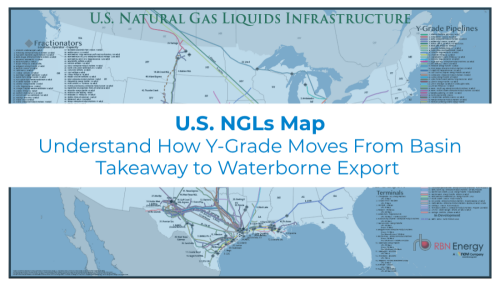
Visualize the infrastructure behind U.S. NGL movement.
The U.S. NGLs Map provides a comprehensive view of the transport, processing, and export networks moving NGLs across the U.S.
Prior to the COVID-19 pandemic and the subsequent global market crash, U.S. LNG facilities operated mostly at their contracted capacity. Feedgas for LNG exports steadily ramped up from zero in early 2016 to just above 9 Bcf/d in early 2020, with feedgas demand increasing with each new liquefaction train that came online and only deviating to the downside when operational issues or maintenance reduced capacity or to the upside in order to produce the occasional spot market cargo. In April 2020, however, with winter demand subsiding, COVID lockdowns spreading worldwide with no end in sight, and global gas prices nearing rock bottom, offtakers began canceling cargoes from U.S. LNG plants. Just about every Gulf Coast LNG terminal had to pare back operations and partially shut-in production, which sent feedgas plummeting even as new capacity came online (See LNG Interruption and Sultans of Swing for more). Figure 1 below shows the growth in daily feedgas volume (orange line) compared with the estimated feedgas requirement at full-contracted capacity at all the operating Lower-48 terminals combined (black line). As you can see below, prior to the pandemic, feedgas tracked the capacity line closely. However, cargo cancellations curtailed feedgas demand from April to October last year (dashed blue oval), peaking in July and August. At the same time, more than 10 MMtpa or nearly 1.4 Bcf/d of new LNG capacity ramped up as Freeport, Cameron and Elba all brought new trains online during the six-month period that saw the cargo cancellations.
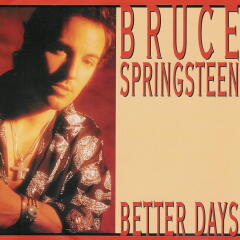
About the song
"Better Days" was written by Bruce Springsteen and is the first song on Springsteen's 10th studio album, Lucky Town. Released as the first single from the album in March 1992, the song went to #16 on the Billboard Hot 100 Singles chart. Personnel on the record were: Bruce Springsteen (lead vocals, guitar, keyboards, harmonica, percussion), Gary Mallaber (drums), Randy Jackson (bass), and Patti Scialfa, Soozie Tyrell, Lisa Lowell (backing vocals).
Lucky Town was recorded between September 1991 and January 1992 at Thrill Hill Recording and A&M Studios in Los Angeles. Produced by Springsteen, along with Jon Landau, Chuck Plotkin, and Roy Bittan, the album was released simultaneously with the LP Human Touch in March 1992. Springsteen had been working on Human Touch since 1990, and when he had written and recorded 10 new songs since wrapping up the LP, he decided to release two new albums at the same time. Lucky Town is a more personal, stripped-down folksy record than Human Touch. Lucky Town went to #3 on the Billboard Top 200 Albums chart and has been certified Platinum by the Recording Industry Association of America (RIAA). Human Touch went to #2 on the Billboard Top 200 chart. It too was certified Platinum by the RIAA. Four singles were released from Lucky Town, three from Human Touch.
Bruce Springsteen is an American singer, songwriter, and musician. He has released 20 studio albums, 23 live albums, eight compilation albums, one soundtrack album, seven EPs, and 73 singles. He has sold more than 135 million records worldwide. He has earned 20 Grammy Awards, two Golden Globes, one Academy Award, and one Tony Award. Springsteen is a member of the Rock and Roll Hall of Fame and the Songwriters Hall of Fame. He has received Kennedy Center Honors, the Presidential Medal of Freedom, and a Woody Guthrie Prize. Springsteen continues to record and tour.