The U.S. carbon-capture industry got a boost this week when up to $3.1 billion in new funding was made available through a pair of initiatives announced by the Department of Energy.
In the first funding opportunity, announced December 17, the DOE opened up applications for up to $1.3 billion in funding for investments in carbon capture, utilization and storage (CCUS) technologies. The DOE said it plans to fund up to 11 projects in three areas: 1) commercial-scale projects integrated with carbon dioxide (CO2) transportation and storage infrastructure; 2) large-scale pilot projects that demonstrate advances in carbon-capture technology; and 3) the planning and design of shared CO2 transport and storage infrastructure that networks of nearby carbon-capture projects can use. Concept papers are due by March 1 and full applications are due by July 1. (For more about CO2 and carbon capture, see Way Down in the Hole.)
In the second initiative, announced December 19, the DOE opened up applications for up to $1.8 billion in funding for the design, construction and operation of direct air capture (DAC) facilities and infrastructure as part of the Regional DAC Hubs program. The DOE said it plans to fund projects in three areas: 1) infrastructure access platforms, or host sites, to provide DAC developers with a place to build and operate facilities; 2) mid-scale commercial DAC facilities with a capture capacity of 2,000-25,000 MT/year; and 3) large-scale commercial DAC facilities able to capture at least 25,000 MT/year. Pre-applications are required for #1, while concept papers are required for #2 and #3. Concept papers and pre-applications are due by January 31, with full applications due by July 31.
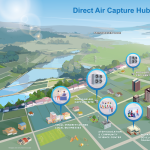
The Regional DAC Hubs program will develop four domestic hubs. Each hub (see schematic below) will demonstrate a DAC technology or suite of technologies at a commercial scale with the potential for capturing at least 1 million MT/year. (For more on the hubs program, see Stuck in the Middle With You.)