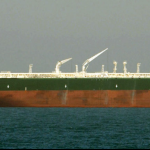
The White House is considering a 30-day waiver of the Jones Act that would allow foreign tankers to move goods between U.S. ports in a bid to ease gasoline prices.
White House press secretary Karoline Leavitt said in a statement Thursday that the administration is reviewing a temporary suspension of the law. Bloomberg reported the Trump administration plans to issue 30-day waivers to permit foreign-flagged vessels to ship fuel to East Coast refiners from the Gulf and other U.S. hubs, citing people familiar with the plan.
Reuters said oil and shipping companies have been told to prepare for a possible waiver.
The Jones Act — formally Section 27 of the Merchant Marine Act of 1920 — requires goods shipped between U.S. ports to travel on vessels that are U.S.-built, U.S.-owned, U.S.-flagged, and primarily U.S.-crewed. The law was designed to protect the domestic shipbuilding industry and ensure a reliable U.S. merchant fleet for national defense and emergency preparedness.
The requirements the Jones Act imposes on ships operating between U.S. ports add costs, including less-favorable economies of scale at U.S. shipyards, reduced competition among U.S. shipbuilders, and higher wages and insurance costs for Jones Act workers. Those higher costs have reduced the number of ships built for “coastwise” and inland movement of crude oil, and the relatively small size of the U.S.-flagged fleet, along with increased competition for Jones Act vessels, has resulted in sharply higher charter costs and shipping fees. Charter costs and shipping fees, of course, are key factors in determining whether transporting crude on a Jones Act vessel makes economic sense in a particular situation.
Since the conflict in Iraq, crude oil prices shot up quickly. WTI crude oil at Cushing, OK, mostly traded in a $55-$65/bbl range in January and February and settled at $67.02/bbl on Friday, February 27, the last trading day before the attacks against Iran began. Prices have moved steadily higher since then, with a high settlement of $96.40/bbl on March 12.
Oil has been mostly stranded through the Strait of Hormuz, one of the most important arteries in the global oil trade. Roughly one in every five barrels of seaborne crude normally passes through the Strait of Hormuz. The sudden disruption has sidelined a large share of Persian Gulf exports, reducing activity to just 10%-15% of normal levels, with crude prices soaring into the triple digits over the weekend.
In addition to possibly waiving the Jones Act, other efforts are underway to reduce gas costs. On March 11, the International Energy Agency (IEA) announced that its 32 member countries had unanimously agreed to release up to 400 MMbbl from their emergency reserves to the market to help ease supply disruptions tied to the war in the Middle East. As discussed in this week's Crude Billboard, with IEA members collectively holding over 1.2 billion barrels of emergency stockpiles, this is the largest coordinated draw in the agency’s history, eclipsing the 183 MMbbl release in 2022 following Russia’s invasion of Ukraine. As part of a global response, the U.S. said it would release 172 MMbbl of crude oil from its Strategic Petroleum Reserve (SPR).