


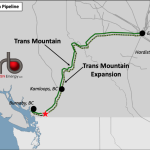
In what developers of the Trans Mountain pipeline expansion hope to be the final push toward completion, construction activities have resumed on the pipeline. A work stoppage order was issued by the Canada Energy Regulator (CER) earlier this month due to a series of environmental violations, including insufficient fencing to protect amphibians and unapproved vegetation clearing, along with safety-related non-compliance issues uncovered by inspectors. The order applied to a key remaining 800-meter segment of the pipeline crossing a wetland area near Abbotsford, BC (red star on map).
Featured Articles
- Analyst Insight
Trans Mountain Pipeline Eyes Critical Hearing
Trans Mountain pipeline is headed for a critical regulatory hearing


- Blog
Waiting on the World to Change, Part 4 - Could ACP, MVP Delays Bring Back Northeast Gas Takeaway Constraints?
With recent project completions, Northeast takeaway constraints have eased, and regional supply prices have strengthened. But now the slate of planned pipeline expansions is dwindling. Between late-2015 and the end of 2018, midstreamers will have completed 23 takeaway projects out of Appalachia, totaling nearly 14.5 Bcf/d of capacity. That leaves just a handful of projects with little more than 6 Bcf/d of capacity to come, most of them facing stiff environmental opposition, regulatory turmoil and higher costs. Yet, as Appalachian gas production continues to grow, these projects will be critical to keeping the takeaway constraints and depressing supply pricing from returning, at least for a little longer. More than half of the remaining capacity would come from two competing projects — Dominion Energy’s Atlantic Coast Pipeline (ACP) and EQM Midstream Partners’ Mountain Valley Pipeline (MVP) — both greenfield efforts tied to growing gas-fired power generation demand along the Mid- and South-Atlantic seaboard and both embattled by a barrage of legal challenges. In today’s blog, we provide an update on the Atlantic Coast and Mountain Valley projects, including the latest status and timing.


- Blog
You've Got Another Thing Comin' - How Will Steeper Tolls on Trans Mountain Impact Crude Flows?
Western Canada’s Trans Mountain Expansion Project, better-known as TMX, has experienced more than its share of setbacks over the past 10 years: environmental protests, legal challenges, financing issues, an ownership change, and even a serious flooding event in 2021. But it seems the 590-Mb/d expansion of the now-300-Mb/d Trans Mountain Pipeline (TMP) system will finally become a reality by early 2024, enabling large-scale exports of Alberta-sourced crude oil to Asian markets. There’s a catch, though. The project’s long delays and other issues resulted in massive cost overruns that are now being reflected in the preliminary tolls for the soon-to-be-combined Trans Mountain system. The proposed toll increase is so large that it will cost a similar amount to ship heavy crude oil to tidewater on Trans Mountain as it would on the competing Enbridge system to the U.S. Gulf Coast for “re-export,” despite the latter being three times the distance. In today’s blog, we discuss the history of the Trans Mountain expansion, its cost overruns and the calculations that went into the proposed tolls — the kicker being that those tolls could end up being even higher.
