


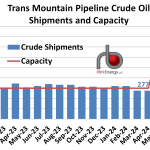
Combining recently published data to June 2024 from Statistics Canada (StatCan) with more recent tanker flow data to the end of August from Bloomberg, RBN estimates that crude oil shipments on the newly expanded Trans Mountain Pipeline have been averaging 686 Mb/d in the most recent three months ending in August (blue columns in chart below).
Featured Articles


- Blog
Both Sides Now - Has the Trans Mountain Expansion Shifted Western Canada’s Crude Oil Exports?
After a decade-long odyssey and a cost-per-mile that must make public-sector accountants in Ottawa wince, the Canadian government-owned Trans Mountain Expansion Project (TMX) — which nearly tripled the capacity of the original Trans Mountain Pipeline (TMP) from Alberta to the British Columbia (BC) coast — finally came into service in May 2024. As one of Canada’s most anticipated energy infrastructure projects in many years, the 590-Mb/d TMX pipeline — built alongside the long-standing 300-Mb/d TMP — was widely touted by its advocates as a surefire way to boost exports of Western Canadian crude and reduce the nation’s near-complete reliance on exporting crude oil to — and through — its primary customer, the U.S. In today’s RBN blog, we discuss some of the surprising (and not so surprising) market developments since the expansion project started.


- Blog
Did You Ever Know That You’re My Hero? - One Year In, Trans Mountain Reaches Record Crude Shipments
It has been 12 months since the Trans Mountain Expansion Project — aka TMX — finally began operations after years of delay, creating a much-needed, larger conduit to move Western Canada’s rising crude oil production to the Pacific Northwest and overseas markets. Although the customer base for exports remains limited, the Trans Mountain pipeline system has been responsible for opening up entirely new markets for Canadian crude. As we discuss in today’s RBN blog, despite its numerous delays and immense cost, the pipeline has recently seen record crude shipments and is nearing its nameplate capacity, driven by rising exports.


- Blog
You've Got Another Thing Comin' - How Will Steeper Tolls on Trans Mountain Impact Crude Flows?
Western Canada’s Trans Mountain Expansion Project, better-known as TMX, has experienced more than its share of setbacks over the past 10 years: environmental protests, legal challenges, financing issues, an ownership change, and even a serious flooding event in 2021. But it seems the 590-Mb/d expansion of the now-300-Mb/d Trans Mountain Pipeline (TMP) system will finally become a reality by early 2024, enabling large-scale exports of Alberta-sourced crude oil to Asian markets. There’s a catch, though. The project’s long delays and other issues resulted in massive cost overruns that are now being reflected in the preliminary tolls for the soon-to-be-combined Trans Mountain system. The proposed toll increase is so large that it will cost a similar amount to ship heavy crude oil to tidewater on Trans Mountain as it would on the competing Enbridge system to the U.S. Gulf Coast for “re-export,” despite the latter being three times the distance. In today’s blog, we discuss the history of the Trans Mountain expansion, its cost overruns and the calculations that went into the proposed tolls — the kicker being that those tolls could end up being even higher.
