


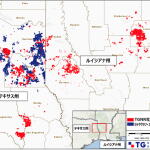
Tokyo Gas, through it's majority-owned subsidiary TG Natural Resources (TGNR), a partnership with Castleton Commodites, has announced the purchase of Rockcliff Energy, for $2.7B. This acquisition brings 200,000 net acres and 1.3 Bcf/d of East Texas Haynesville natural gas production and a large position as a driller and operator to TGNR. This is not Tokyo Gas's first foray into the US upstream business, however, it is an attention-grabber. TGNR is an established non-operated investor in the Haynesville and Cotton Valley, with over 188,000 net acres and 330 mmcf/d production prior to the Rockcliff acquisition. The map below shows the existing TGNR acreage in red and the acquired Rockcliff acreage in blue.
Featured Articles


- Blog
We're an American Band - Foreign Firms Step Up Investments in U.S. Production and Infrastructure
The uncertainty and angst spurred by the ongoing trade war doesn’t seem to have dampened foreign companies’ interest in acquiring upstream and midstream energy assets in the U.S. The recent rumor — still unconfirmed — that Mitsubishi Corp. is in talks to acquire Aethon Energy Management’s massive holdings in the Haynesville for a reported $8 billion is only the latest indication that overseas interest may be stronger than ever. In today’s RBN blog, we’ll discuss the latest round of foreign investments in U.S. energy and what’s driving those deals. We’ll also look at the Aethon assets on the block.


- Blog
American Pie - LNG Buyers and Suppliers Acquiring Slices of Their U.S. Feedgas Needs
The U.S. is now the world’s #1 supplier of LNG and the new liquefaction/export capacity slated to come online over the next few years suggest it will hold that position into the 2030s. To control more of the LNG value chain and become more familiar with the inner workings of the U.S. natural gas market, a small-but-growing number of LNG buyers and suppliers have been acquiring gas production assets close to LNG export terminals along the U.S. Gulf Coast — in other words, buying slices of the American gas-supply pie. In today’s RBN blog, we discuss the LNG market players pursuing this strategy, what they’ve been buying, and how their acquisitions may benefit them.


- Blog
We Three Kings - U.S., Australia and Qatar Look to Grow LNG Exports Amidst Global Uncertainty
About 60% of global LNG imports in 2023 came from only three countries — Australia, Qatar and the U.S. — sometimes dubbed the “LNG Trinity.” All three are geographically remote from each other and differ considerably in terms of configuration, politics, economics and strategy. But all three are looking to consolidate and potentially grow their global presence at a time when expectations regarding future LNG demand are evolving and the role of natural gas is shifting to become increasingly complementary to intermittent renewable sources. In today’s RBN blog, we look at the differences within the LNG Trinity and how they may impact — and be impacted by — developments in the global gas market.
