


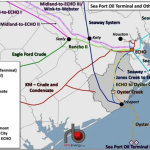
Five years after its original United States Maritime Administration (MARAD) application, Enterprise's Sea Port Oil Terminal (SPOT) deepwater export project has been approved for a Deepwater Port License. This milestone is undoubtedly a big win for Enterprise. Some of the advantages of SPOT in particular include the ability to moor two VLCCs and load one per day, building on the cost savings available to shippers who load VLCCs in one of the Corpus Christi terminals that can (either South Texas Gateway or Enbridge Ingleside Energy Center). It would be located about 30 nautical miles off the Texas coastline (purple & white striped diamonds in figure below). Enterprise is planning to construct dual 36" bi-directional pipelines to connect the terminal to the rest of their integrated midstream network (orange-dashed line below), to its proposed Oyster Creek Terminal (orange & white striped tank icon below) with 4.8 MMbbl of planned capacity, and to the Enterprise Houston ECHO terminal (yellow-dashed line & orange tank icon below).
Featured Articles


Leader of the Pack - Deepwater Port License in Hand, Enterprise's SPOT at Front of Export Terminal Race
In the race to build the next deepwater crude oil export terminal along the U.S. Gulf Coast, there’s a lot of competition but one project now has a clear advantage: Enterprise Product Partners’ planned Sea Port Oil Terminal (SPOT), which has made the most progress in moving through the regulatory morass and announced that it had received its deepwater port license on April 9. In today’s RBN blog, we provide an update on SPOT’s progress and look at some of its inherent advantages, including a potentially shorter time to market and extensive pipeline connectivity.
Enterprise likely targeting year-end 2024 for FID on SPOT


(Gulf) Deep, Mountain High - The Race to Build Texas's First Offshore Crude Export Terminal
As we see it, 2023 will be another strong year for U.S. crude oil exports, driven in large part by rising domestic production. Upstream companies in the Permian and other U.S. shale plays are gradually ramping up their output and, with domestic refineries largely maxed out on how much light-sweet oil they can use, it’s safe to say that the vast majority of the incremental oil produced will end up at export terminals along the Gulf Coast. And if production continues growing (as we expect), there’s likely to be room — and a strong economic rationale — for one or more new offshore terminals to be built in the deep waters of the Gulf itself. Each of these proposed facilities would offer shippers what they want most: easy access to large volumes of oil and the ability to fully load 2-MMbbl VLCCs without any reverse lightering, which brings cheaper and cleaner export options to the market. In today’s RBN blog, we provide updates on two offshore projects still in the running: Sentinel Midstream’s Texas GulfLink and Phillips 66 and Trafigura’s Bluewater Texas.
