


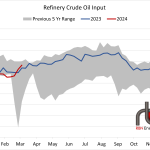
According to recent EIA data, total net refinery input rose by 400 Mb/d to 15.66 MMb/d, representing a solid two week rebound from the recent lows of 14.5 MMb/d. Gross refinery input jumped by 350 Mb/d to 15.6 MMb/d, which pushed U.S. refinery utilization rate to 86.8%, the highest since the week ended January 12. Gross input jumped by 440 Mb/d in PADD 3, where utilization rose to 89.7%, now up 840 Mb/d in the past two weeks. Part of this comes as Marathon restarts its 593 Mb/d Galveston Bay refinery, and its 578 Mb/d Louisiana refinery.
Featured Articles


- Blog
Carry That Weight – U.S. Natural Gas Market Begins Injection Season with Record Storage Overhang
U.S natural gas storage inventories ended the winter heating season at a record high for this time of year of 2,480 Bcf as of April 1, 2016. Yesterday (Thursday April 14) the Energy Information Administration (EIA) reported that U.S. natural gas storage fell a notch as of April 8 to 2,477 Bcf or 956 Bcf (63%) higher than the corresponding week last year. CME/NYMEX Henry Hub natural gas futures prices for May delivery closed at $1.970/MMBtu yesterday, 56 cents lower than last year at this time. Moreover the current 12-month strip is averaging $2.48, 32 cents lower than last year at this time. In today’s blog, we look at how inventories got here and implications for the summer market.


- Blog
I Still Haven't Found All the Crude Storage I'm Looking For - PADD 2
The famous Field of Dreams misquote “If you build it, they will come” certainly has proved true for the midstream companies that added a record 18.7 MMbbl of crude oil storage capacity in PADD 2 in late 2015 and early 2016. During that six-month period, crude inventories in PADD 2 blasted 24.4 MMbbl higher to a record 155.6 MMbbl. And while PADD 2 oil stockpiles have been shrinking somewhat in recent weeks, they remain above 150 MMbbl—a mark the PADD had never seen before this year. Storage levels have been particularly high at the Cushing, OK storage and distribution hub within PADD 2. Why is so much crude being socked away? Today, we continue our look at the new storage capacity being added in the U.S., and at why demand for storage has been so high.


- Blog
Diversified E&Ps' 2022 Capex & Production
<p>Note: Columns are sortable by clicking once or twice on the column title.</p>
