


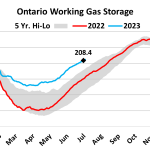
Ontario, Canada’s second largest working gas storage region and the closest to the most populous gas consuming markets in the eastern half of the country, finished June at a record of 208.4 Bcf of gas in storage (black diamond in top chart). This was 56.5 Bcf (+36.4%) higher than one year ago and 28.8 Bcf (+15.7%) higher than the five-year average. The record comes after one of the warmest winters (2022-23) and smallest heating season cumulative storage withdrawals experienced in the past decade and adds to what is already an oversupplied gas market across Canada.
Featured Articles


- Blog
Don't Be Afraid - Low Alberta Gas Storage Is Not Spooking the AECO Winter Market, Yet
Alberta natural gas storage, one of the largest regional storage hubs in North America, is experiencing one of its slowest cumulative storage injection rates in years and could be headed to a 13-year low for storage levels by the end of the current injection season. That may seem ominous for the chilly Alberta and Canadian winter heating season, not to mention gas exports to the U.S. So far, though, winter gas forward prices for the Western Canadian gas price benchmark of AECO have registered a relatively modest market response, staying in line with last winter’s average spot price. Today, we take a closer look at the market’s apparent lack of concern over low Alberta gas storage.


- Blog
East Bound and Down - Western Canada Gas Storage Faces Very Low Starting Point for Next Winter
Canadian gas storage levels concluded the most recent heating season at multi-year lows, especially in the western half of the nation, which hit a 16-year low at the end of March. Though storage sites have been refilling at a steady rate so far this summer, storage in the west, a region vitally important for balancing the North American gas market during high winter demand, remains unusually low for this time of year. In today’s RBN blog, we examine the latest developments in Canadian natural gas storage and explain why storage levels in Western Canada may start the next heating season at critically low levels.


- Blog
I Was Made for Storing You - How Much Natural Gas Storage Capacity Does Alberta Really Have?
For natural gas markets to operate as efficiently as possible, a lot of data is needed, including up-to-date estimates of the amount of gas in storage and the physical capacity to hold it. For too long, Canadian natural gas markets have been operating with an obvious blind spot: little to no reliable storage data. With Alberta being home to the largest amount of gas storage capacity in Canada, having accurate information could provide vital data in the pricing of Canadian natural gas. In today’s RBN blog, we begin a multi-part series examining Canadian natural gas storage, starting with Alberta.
