Strong producer activity in the Permian Basin and additional pipeline capacity will increase demand for natural gas gathering, processing and treating capacity, Kinetik said during its Q3 2026 earnings call on November 4.
More than 7 Bcf/d of new Permian pipeline egress capacity has been announced over the last three months, the company said, and it expects more than 13 Bcf/d to come online from 2028 through 2030, providing the downstream infrastructure necessary to support the next phase of Permian Basin growth.
“We are strong believers that the Permian's best days are still ahead. Producer activity is increasingly extending beyond the traditional core oil benches into gassier formations with higher gas-to-oil ratios, including the Woodford, Avalon, First Bone Spring and Penn Shale,” President and CEO Jamie Welch said. “These development trends are significantly increasing demand for gathering, processing and treating capacity, and play directly to the strengths of our integrated footprint. At the same time, localized Waha egress constraints have begun to ease.”
Welch said it is increasingly clear that additional processing infrastructure is needed to keep pace with expected producer activity. The company’s Kings Landing complex (#1 in slide below) and its other New Mexico processing complexes operated at full capacity for much of Q3, so its ECCC Pipeline (#4) flowed surplus volume south into Texas. In September, Kinetik elected to upsize its KL II processing complex (#2) from the originally planned 300 MMcf/d to 380 MMcf/d. It remains on track for mid-2028 in service.
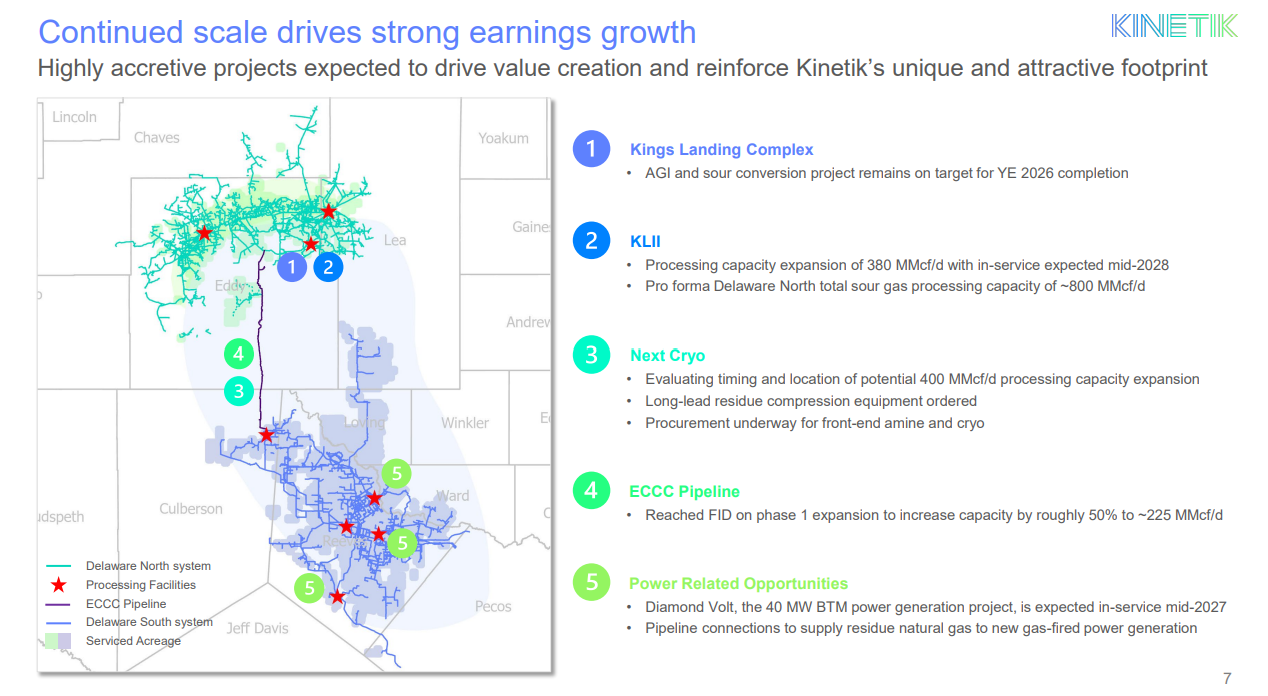
Source: Kinetik
Welch said the company is also investing in targeted projects that add incremental capacity and operational flexibility across the system.
“For example, at Pecos Bend, we are undertaking treating upgrades that will support higher inlet CO2 concentrations and additional volumes moving into Delaware South,” Welch said. “We are also procuring additional compression equipment to be deployed across our gathering system to further support growing producer volumes and proactively manage our supply chain.”