


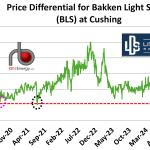
The price differential for Bakken Light Sweet (BLS) crude oil that is shipped from North Dakota on the Pony Express Pipeline for physical delivery into Cushing, OK, has been hitting its lowest values since June/July 2020 over the past two weeks. As discussed in RBN’s TradeView report, the price differential dipped at the end of last week to just $0.05/bbl (red oval in chart below) over the price of NYMEX-CME Domestic Sweet (DSW) – the commonly quoted prompt-month futures contract price of crude oil. Other than a one-day blip to zero ($0.00/bbl) due to pipeline issues in June 2021 (black dashed oval), this is the weakest for the BLS price differential since a string of soft values at $0.10/bbl or lower in June/July 2020 (pink dashed oval and red dashed line for comparison), 4 1/2 years ago when the physical oil markets were still sorting out COVID-related market disruptions.
Featured Articles
Mars Crude Price Differential Recovers on Tariff Uncertainty and Supply Tightness
Gulf Coast Sour Crude Price Differential Hits Near Five-Year High on Tariff Turbulence


The Price is Right - North America Crude Oil Price Differentials Explain and Foretell Market Shifts
There is no debate about it: The CME/NYMEX domestic sweet (DSW) crude oil futures prompt-month contract at Cushing, OK, is the most closely followed benchmark in U.S. energy markets. It’s the price quoted in nightly news reports and general media publications. And now, with U.S. exports of WTI deliverable on the Brent contract, domestic sweet at Cushing is arguably setting the price for crudes around the world. But the fact is, most crudes traded in physical markets across North America are not priced at the DSW-at-Cushing benchmark but instead at a differential to Cushing — higher or lower on any given day based on each crude’s unique quality, location, and supply/demand characteristics. In today’s RBN blog, we discuss how the behavior of differentials from the Cushing benchmark can go a long way to explain what is happening with crude oil production, transportation volumes, storage and, of course, exports.
