


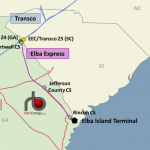
During its recent quarterly earnings report, Kinder Morgan discussed a potential expansion of the Elba Express pipeline called Elba Express Bridge. The new pipeline extension would be 71 miles in length and transport an incremental 325 MMcf/d of gas from the Transco system to markets in South Carolina. However, Kinder Morgan noted that the pipeline could easily be expanded to 1 Bcf/d if demand warranted it.
Featured Articles


- Blog
Let Me Move You, Part 5 - How LNG Exports Will Change Gulf Coast Natural Gas Markets in 2019
One of the biggest factors affecting the U.S. natural gas market in 2019 will undoubtedly be the dramatic rise in LNG export demand. The slate of liquefaction and LNG export capacity additions this year will boost U.S. demand for feedgas supply to nearly 9 Bcf/d by the end of the year, almost tripling the 2018 full-year average of 3.1 Bcf/d and close to doubling the December 2018 average of 4.6 Bcf/d, with the lion’s share of that growth happening along the Texas and Louisiana Gulf Coast. Three liquefaction trains — one each at Cheniere Energy’s Sabine Pass and Corpus Christi terminals, as well as one at Cameron LNG — are likely to be fully operational in the first quarter, with five additional trains due in rapid progression later in 2019. That much new gas demand concentrated in one region is bound to disrupt physical flows and pricing dynamics. Today, we wrap up the series with a look at the timing and feedgas routes for the final two facilities: Freeport LNG in Texas and Kinder Morgan’s Elba Island project in Georgia.


- Blog
Give More Power to the People - Soaring Power Needs Drive Gas Demand in Virginia and Carolinas
The Mountain Valley Pipeline (MVP) and planned expansions to it and the Transcontinental Gas Pipe Line (Transco) system are providing utilities, data centers and others in Virginia and the Carolinas with enhanced access to Marcellus/Utica-sourced natural gas — and man, will they need it! Plans for new generating capacity between Washington, DC and the South Carolina/Georgia state line are proliferating, and the increasing ability to move large volumes of gas south on MVP and Transco will give producers in Pennsylvania, West Virginia and Ohio an important incremental outlet for their gas well into the 2030s. In today’s RBN blog, we’ll discuss the boom in power demand in Virginia, North Carolina and South Carolina and the very timely expansion of gas-pipeline access to three states.


- Blog
Don’t Stop Believin' - Is the Marcellus/Utica Finally Poised for a Gas-Production Breakout?
The Marcellus/Utica region is by far the most prolific natural gas production area in the U.S., accounting for about one-third of the nation’s daily output. The shale play experienced phenomenal growth in the 2010s, its gas production rising from less than 2 Bcf/d to more than 33 Bcf/d over that decade. But the pace of growth has slowed dramatically in recent years, mostly due to takeaway constraints. In today’s RBN blog, we discuss how a combination of new pipeline projects, in-basin data center development and incremental Gulf Coast LNG demand might breathe new life into the Marcellus/Utica.
