


Re-exports of Canadian heavy crude oil are estimated to have been 145 Mb/d in October 2025 (rightmost stacked columns in chart below), an increase of 45 Mb/d from September, itself a six-month low, and 145 Mb/d more than a year ago based on tanker tracking data compiled by Bloomberg. Since the departure last year of China (red columns) from the Gulf Coast in favor of Canada’s west coast as a buyer of Canadian crude, two nations have remained prominent in purchasing Canadian barrels, partly motivated by logistical proximity. India (gray columns) lifted 63 Mb/d, nearly twice the level of September (33 Mb/d) and 63 Mb/d more than a year ago. Spain (blue columns) bought 83 Mb/d, 17 Mb/d more than September and 83 Mb/d more than a year ago. Data for the most recent three months are derived from Bloomberg tracking estimates as official monthly data from the U.S. Census Bureau beyond July remains unavailable until further notice.
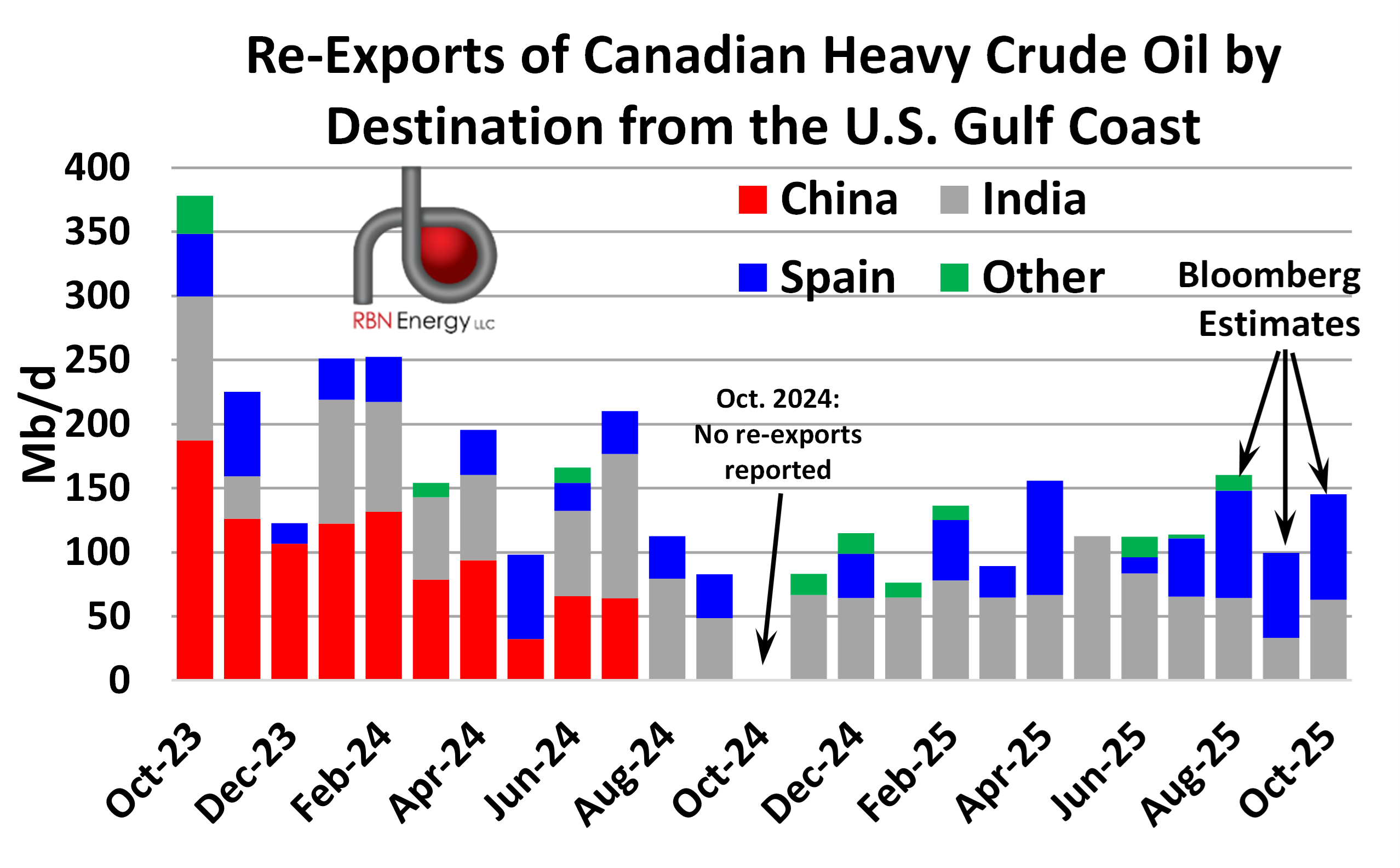
The increase in re-exports may be reflecting a shift in purchase patterns by India and Spain as they attempt to maneuver around sanctions on portions of the global oil tanker fleet and those directed against Russia. This is of particular importance for India, a frequent and sizeable buyer of discounted Russian crude in the past few years. Its latest increase in purchases of Canadian heavy oil from the Gulf may be a possible first step to higher volumes in the future as it diversifies its crude import slate to a broader suite of exporting nations.
