


Re-exports of Canadian heavy crude oil are estimated to have reached a four-month high of 151 Mb/d in December 2025 (rightmost stacked columns in chart below), an increase of 70 Mb/d from November, and 36 Mb/d more than a year ago, based on tanker tracking data compiled by Bloomberg. Since the departure last year of China (red columns) from the Gulf Coast in favor of Canada’s west coast as a buyer of Canadian crude, two nations have remained prominent in purchasing Canadian barrels from the Gulf Coast: India and Spain. India (gray columns) is estimated to have purchased 65 Mb/d, 16 Mb/d less than November and unchanged versus one year ago. Spain (blue columns) was a buyer of 86 Mb/d, up from zero in November and 52 Mb/d more than last year.
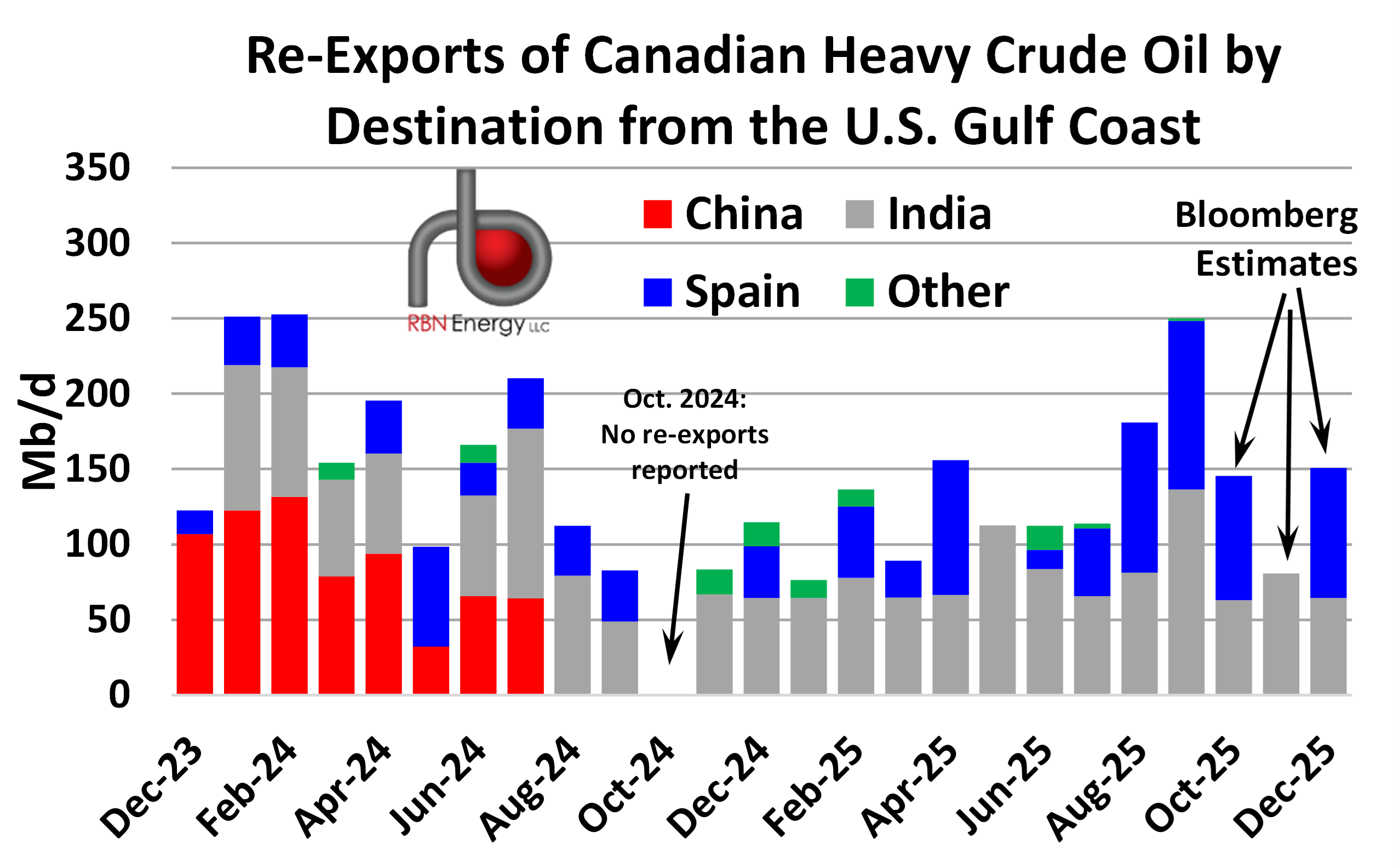
Data for the most recent three months are derived from Bloomberg tanker tracking estimates. Official monthly data from the U.S. Census Bureau has been updated to September which revealed a significant upward revision of 150 Mb/d to 250 Mb/d, with re-exports to India and Spain each being more than doubled to 136 Mb/d and 112 Mb/d, respectively, versus prior estimates (also 2 Mb/d to Peru) and underscoring the very preliminary nature of the Bloomberg data.
The path forward for Canadian heavy oil re-exports has become clouded with the possibility of increased imports of Venezuelan heavy oil into the Gulf Coast. However, re-exports are unlikely to be eliminated given rising production from Alberta’s oil sands and plans already underway to increase pipeline capacity from Canada to the Gulf Coast (and more being considered, see Let’s Get It Started for details). The most probable outcome would be a deepening of the price discount for these barrels to the point where they economically meet the needs of Gulf Coast refiners and other importing nations in the presence of increased heavy oil competition from Venezuela.
