


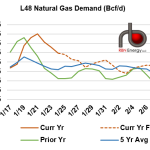
As many energy market participants are increasingly concerned over the impact of potential tariffs between Canada and the US, data from this week underscored the importance that trade between the two countries has in the gas market. Net imports of Canadian gas were 10.24 Bcf last Tuesday as harsh winter weather simultaneously slammed the East Coast and Gulf Coast. This led gas demand in the U.S. Lower 48 to soar to 145.1 Bcf on Tuesday, which is more than 31 Bcf above the 5-year average, as seen in the chart below. The only other day in the past decade that saw higher net Canadian imports was Christmas Eve of 2022, when they hit 10.25 Bcf.
Featured Articles


- Blog
Summertime Sadness - Is the Rangebound Summer Gas Market Heading for a Breakout?
The summer of 2024 proved somewhat melancholy for natural gas bulls, but also for bears, as front-month futures have consistently sported a $2 handle on the vast majority of trading days. What happened to the dire predictions of oversupply heard this past winter? And what about the bullish swing that took over the market in early June? Developments in production and weather have ameliorated both concerns but new issues may cause volatility to return in the near future. In today’s RBN blog, we’ll detail what happened during this summer’s gas market and what current trends portend for the fall and winter.


- Blog
East is East, West is West - U.S. Natural Gas Spot Prices Race to $600/MMBtu as Midcon Runs Out of Gas
Physical natural gas spot prices in the U.S. Midcontinent trading as high as $600/MMBtu, while Northeast prices barely flinch – that was the upside-down reality physical traders were contending with Friday in trading for the long weekend, with Winter Storm Uri bearing down on large swaths of the Lower 48 and spreading bitter-cold, icy weather from the Midwest and Northeast to Texas and the Deep South. The record-shattering, triple-digit spot prices, mostly all west of the Mississippi River, were indicative of some of the worst supply shortages the market has seen during the generally oversupplied Shale Era, or ever. But the East vs. West price divergence also marks the culmination of years of shifting gas supply and flow patterns that have redefined regional dynamics. The market will be digesting the various impacts of this still-unfolding event for days, but some of the effects and implications can be gleaned already from daily pipeline flows. In today’s blog we provide an early look at the market impacts of the polar plunge.


- Blog
Out of This World – Latest Cold Blast Sets New Records for the Canadian Gas Market
In a part of the world where enduring a cold winter is often seen as a badge of honor, the latest cold blast that descended on Canada just before Christmas — and during Christmas in the U.S. — was another one for the natural gas record books. By almost every measure, the recent frigid temperatures, though not long-lasting, set new Canadian records for daily demand, storage withdrawals, and net exports to the U.S., and went well beyond the records set during Winter Storm Uri in February 2021. In today’s RBN blog, we delve into the latest record-busting Canadian gas data.
