


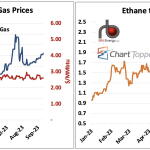
Mont Belvieu ethane prices peaked in mid-July at almost 40 c/gal but quickly fell back to around 26 c/gal where they remained until late August. But prices have been creeping higher lately, closing at 31 c/gal yesterday according to OPIS (see left-hand chart below). Like the rally in July, the increase in ethane can’t be blamed on natural gas. Natural gas prices have been relatively flat which has pushed up the ethane to Henry Hub ratio to nearly 1.8x (see right-hand chart below). So what is behind the recent strength in ethane prices? Part of reason is likely higher petchem demand with ethylene prices rising to almost 21 c/lb. In addition, Gulf Coast ethane exports have remained robust with Enterprise’s Morgans Point terminal and Energy Transfer's (Orbit J/V) Nederland terminal operating close to capacity. U.S. ethane inventories are also on the low side which could be contributing to the run-up. The increase in prices should incentivize more ethane recovery (less rejection) so the strength in ethane may be short-lived.
Featured Articles


Fly Me to the Moon - Ethane Prices Rocket into Space, then Crash to Earth on Tuesday. What Happened?
In just over a month, the price of Mont Belvieu purity ethane doubled, from 19 c/gal to 39 c/gal on Friday. Sure, the price of natural gas was up about 15% over the same period. But that increase was nowhere near ethane’s, so it was certainly not the price of gas that was making ethane take off. In fact, with ethane rocketing into space and gas prices still in the dumper, the ethane-to-gas ratio — a key measure of the value of ethane — skyrocketed, soaring from 1.2X in mid-June to 2.2X on Friday. A ratio at this level has only happened twice before in the past decade: once in 2018 due to a collision between fractionation capacity and new petchem plants coming online, and then again in 2020 during the COVID petchem demand surge. But the most recent price surge didn’t last long. On Tuesday ethane came back to earth, crashing 22% in a single day, and the ethane-to-gas ratio deflated down to 1.6X. So what’s happening? There are a lot of conspiracy theories out there that we won’t repeat here. Instead, in today’s RBN blog, we’ll lay out what we think are the most likely contributing factors behind this wild ride.


Return to the Ethane Asylum - Price Skyrockets as Supply/Demand Uncertainty Looms for the Lightest NGL
That crazy little ethane molecule is at it again. Yesterday the price blasted to 67.875 c/gal, a level last seen on January 17, 2012. Petchem cracker margins are low. Production is up, but inventories are down. A big driver of the bedlam is the price of natural gas, trading in the $7-$9/MMBtu range for the past month. But as usual with ethane, there’s a lot more happening below the surface — including high domestic demand, growing export volumes, and significant developments in downstream petrochemical markets — all shaking things up. Looking ahead, uncertainty looms, with more export capacity, ever-changing ethane rejection economics, and uneven production growth. In today’s RBN blog, we’ll leap back into the ethane market to see what’s been going on, and where ethane is headed over the next few years.


Ethylene Ethylene, Prettiest Margin I Ever Seen - Ethylene Margins Skyrocket; How Long Will It Last?
How about some good news to start the year? Over the past few weeks, ethylene margins have blasted into the stratosphere. These are good times for steam crackers, those petrochemical plants that use mostly NGL feedstocks to produce ethylene and other building-block chemicals. As you might expect, this newfound prosperity has a lot to do with ethylene’s price. In December alone, the price of ethylene was up 50%; versus April it’s up a whopping 4X, coming in yesterday at 37.5 cents per pound (c/lb). There are a whole range of factors responsible, including petchem outages due to the hurricanes, new downstream derivative units coming online, robust exports from the Enterprise Morgan’s Point dock, and, oh yes, strong demand for downstream products — everything from food packaging to construction materials. Is the spike in ethylene prices going to last? And what does it mean for NGLs, which account for more than 95% of the feedstock supply for U.S. ethylene. We’ll explore those questions and more in this blog series we begin today.
