In just over a month, the price of Mont Belvieu purity ethane doubled, from 19 c/gal to 39 c/gal on Friday. Sure, the price of natural gas was up about 15% over the same period. But that increase was nowhere near ethane’s, so it was certainly not the price of gas that was making ethane take off. In fact, with ethane rocketing into space and gas prices still in the dumper, the ethane-to-gas ratio — a key measure of the value of ethane — skyrocketed, soaring from 1.2X in mid-June to 2.2X on Friday. A ratio at this level has only happened twice before in the past decade: once in 2018 due to a collision between fractionation capacity and new petchem plants coming online, and then again in 2020 during the COVID petchem demand surge. But the most recent price surge didn’t last long. On Tuesday ethane came back to earth, crashing 22% in a single day, and the ethane-to-gas ratio deflated down to 1.6X. So what’s happening? There are a lot of conspiracy theories out there that we won’t repeat here. Instead, in today’s RBN blog, we’ll lay out what we think are the most likely contributing factors behind this wild ride.
Ethane Market
For those who are not steeped in NGLs and petchem feedstocks, we’ll start with a brief ethane market overview. Feel free to skip this if you are an ethane aficionado. Ethane is one of the five NGL “purity products.” It is the lightest of those products, and the most prolific of the NGL siblings, accounting for somewhere around 50% of each barrel of potential NGL production on a national basis, with the percentage varying by basin and within basins. Around 99.9% of the ethane “recovered” is transported by pipeline to a petrochemical plant — more specifically a steam cracker, where it is used as a feedstock to produce ethylene, propylene and other petchems. Note that we underlined “potential” a couple of sentences back, because the ethane recovered at natural gas processing plants is not all the ethane that is in the inlet natural gas stream. Instead of being recovered, some of the ethane is “rejected” into natural gas and sold for its Btu value. In other words, it’s sold at the tailgate of the plant as natural gas at the price of natural gas.
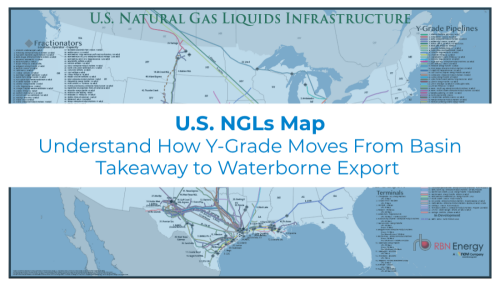
Visualize the infrastructure behind U.S. NGL movement.
The U.S. NGLs Map provides a comprehensive view of the transport, processing, and export networks moving NGLs across the U.S.
It is this either/or attribute for ethane marketability that makes the product a favorite of ours in the RBN blogosphere. Our greatest hits over the years include Ethane Asylum and Where Has All the Ethane Gone, both of which looked at high rejection volumes; Ethane Asylum Revisited, where we considered the impact of a dozen new ethane-only domestic crackers coming online in the 2017-22 period, along with more export capacity; Reason to Believe, which looked at the Gulf Coast Growth Ventures (ExxonMobil-SABIC) cracker near Corpus Christi; and It Takes Two, which examined the link between ethane export-capacity development and long-term commitments from foreign ethylene producers to receive ethane from U.S. suppliers.

About the song
“Fly Me to the Moon” was written by Bart Howard and appears as the second song on side one of Tony Bennett’s 19th studio album, If I Ruled the World: Songs for the Jet Set. Released as a single in April 1965, it went to #84 on the Billboard Hot 100 chart and #17 on the Billboard Smooth Jazz Singles chart. The song was originally titled “In Other Words.” It was first sung in 1954 by Felicia Sanders at the Blue Angel nightclub in Manhattan, where songwriter Howard was the M.C. and piano accompanist. The first recording of the song was by Kaye Ballard in 1954. Many artists have covered the song over the years, with the most popular being Frank Sinatra’s 1964 rendition, which was later associated with the Apollo mission to the moon. Bennett’s beautiful slow and soulful rendition became a staple in his concerts. Personnel on Tony Bennett’s version were: Tony Bennett (vocals), Ralph Sharon (piano), Hal Gaylord (bass), Al Cohn (tenor sax), Carlos Lyra (guitar), Billy Exiner (drums), and Don Costa (orchestrations and choral arrangements).
If I Ruled the World: Songs for the Jet Set was recorded in January-February 1965 at CBS 30th Street Studio in New York City with Ernie Altschuler producing. Released in April 1965, it went to #47 on the Billboard 200 Albums chart. Bennett dedicated his recording of “Sweet Lorraine” on the album to Nat King Cole, who had passed away a month before the album was released. One single was released from the LP.
Tony Bennett (Anthony Dominick Benedetto) was an American jazz and popular song singer. He first entered the spotlight in 1951 when he signed with Columbia Records and had his first #1 hit with the single “Because of You.” His recording of “I Left My Heart in San Francisco,” released in 1962, won him Grammy Awards for “Record of the Year” and “Best Male Solo Vocal Performance,” and became his signature song. He released 61 studio albums, 11 live albums, 33 compilation albums, one EP, and 83 singles, all on the Columbia Records label. He has sold more than 50 million records worldwide. Bennett broke the Guinness World Record for the oldest person to release an album, at 95 years of age. He won 20 Grammy Awards, a Grammy Lifetime Achievement Award, two Primetime Emmy Awards and a Kennedy Center Honor, and has a star on the Hollywood Walk of Fame. Bennett was also an accomplished painter, author, and was well known for his work for civil rights and philanthropy. After being diagnosed with Alzheimer's disease in 2016, Bennett did his final live concerts with Lady Gaga at Radio City Music Hall in New York City in August 2021. He died in New York City in July 2023 at the age of 96. A life well-lived. We at RBN are saddened to hear of Tony Bennett's passing, and wish his family, friends, and fans our sincere condolences.