


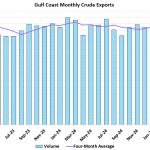
Crude oil exports from the U.S. Gulf Coast (USGC) plunged in July 2025 (orange bar in chart below), marking the lowest recorded monthly volume since January 2023 (green bar at left of chart).According to RBN’s Crude Voyager Report, exports declined by more than 500 Mb/d from June levels to average just 3.1 MMb/d last month. July's volume sits 700 Mb/d below the 2025 year-to-date (YTD) average and 1 MMb/d below export flows for the same month in 2024.
Featured Articles


- Blog
How Much More Can She Stand - Crude Export Capacity at Existing Gulf Coast Terminals
With a number of U.S. producers slashing their drilling plans for 2020, crude oil production may flatten or even decline somewhat in the oil-focused basins over the next few months. Still, large volumes of crude — somewhere north or south of 3 MMb/d — will need to be exported from Gulf Coast docks for the foreseeable future to keep U.S. supply and demand in relative balance. That raises the questions of whether more export capacity will be needed, and if so, how much and when? The answers to these questions depend in large part on how much crude the existing marine facilities in Texas and Louisiana can actually handle. Today, we begin a series that details the region’s export-related infrastructure and examines its capacity to stage and load export cargoes this year and beyond.


- Blog
Slow Down - Combination of Factors Pull U.S. Crude Oil Exports Back From Record Highs
The U.S. has become an oil-exporting powerhouse in recent years, propelled by booming shale production, notably from the Permian Basin. U.S. crude oil now flows more freely than ever to help meet global demand, including to Europe, which increasingly turned to the U.S. following Russia’s invasion of Ukraine two-plus years ago, but exports have slowed recently. In today’s RBN blog, we examine a half-dozen reasons why the export surge has tapered off and why it may not change much in the weeks ahead.


- Blog
Take A Look At Me Now - Enterprise's Ambitious Goal for Expanding Its Hydrocarbon Liquids Exports
Enterprise Products Partners continues to grow its export capabilities and set ambitious goals, including one noted by CEO Jim Teague during his appearance at RBN’s recent NACON: PADD 3 conference — growing liquid hydrocarbon exports by about 50% to a remarkable 100 MMbbl per month (100 MMb/month), or about 3.33 MMb/d. And that doesn’t include the company’s planned Sea Port Oil Terminal (SPOT), which could send out up to 2 MMb/d! While that goal may seem lofty, Enterprise is already a major player in export markets and has extensive hydrocarbon delivery, storage and distribution assets in place to feed its coastal terminals. In today’s RBN blog, we look at the crude oil side of Enterprise’s export machine and show why supply will be key to meeting part of that ambitious goal.
