


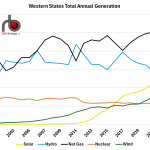
According to preliminary EIA generation statistics released on Tuesday, 2023 recorded the lowest level of conventional hydroelectric generation in over 20 years for the western United States (Arizona, California, Colorado, Idaho, Montana, Nevada, New Mexico, Oregon, Utah, Washington and Wyoming), and the second-lowest since detailed statistics started in 1990. (Red dashed oval on blue line in upper chart below.) It was only 4% more than the lowest level recorded in 2001. But more significantly, even though both solar (yellow line) and wind (green line) have increased substantially, growing by 13,000% and 1,900% to be the second- and fourth-largest generation sources respectively, neither has responded to the year-to-year variations in hydroelectric availabliity. It has been left to natural gas-fired generation (black line) to to pickup the slack.
Featured Articles


Who Stopped the Rain?— Drought Boosting Gas Power Burn Demand in California
Despite some recent rain and snow, California continues to experience a historic drought that will further reduce the state’s hydroelectric output and again increase demand for natural gas for power generation. But the drought is only part of the story. California needs to replace the megawatts once provided by the now-shuttered San Onofre nuclear station, and specifically needs flexible gas-fired capacity to back up the intermittent production from the state’s new solar facilities and wind farms. The resulting gas shortages have led to generators being exposed to massive swings in gas prices this winter and facing higher prices this summer. Today we examine the growing connection between gas use and rain, snow, sun and wind in the Golden State.


Who Stopped the Rain? - Less Hydro Means More Gas Use
Natural gas-fired power generation has always played second fiddle to hydropower in the Pacific Northwest, where dams in the Columbia River Basin typically supply well over half the region’s annual power needs. Gas takes on a more significant role, however, in years like this with lower-than-normal precipitation and hydro generation. And the ongoing phase-out of coal-fired plants in the Pacific Northwest is nudging gas closer to center stage—not just in 2014 but also over the long haul. Today we start a series examining the brightening outlook for gas use in the most hydro-dominant region in the US.


Rocky Mountain Breakdown - Western Natural Gas Markets Whack Rockies Producers
Efforts to increase natural gas production in the Rockies are running into a brick wall — make that several brick walls. To the east, burgeoning gas production in the Marcellus/Utica region is surging into Midwest markets, pushing back on Rockies gas supplies. To the south, Permian gas production is ramping up toward 8 Bcf/d, most of it associated gas from crude-focused wells — volumes that will be produced even if gas prices plummet. To the west, Rockies gas faces an onslaught of renewables in power generation markets, where wind and solar are increasingly replacing gas fired and coal generation, especially during non-peak periods when the sun is shining and the wind is blowing. To the north, Western Canadian producers facing a where-do-we-send-our-gas problem of their own are only days away from having expanded pipeline access to U.S. West Coast markets — access likely to displace some of the Rockies gas which has been flowing west. Today, we discuss highlights from a new report by our friends at Energy GPS that assesses these developments and explores their implications.
