


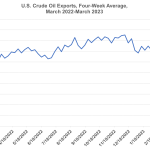
U.S. crude oil exports have been on a steady rise since Russia’s invasion of Ukraine in February 2022 upended the global energy market and sent buyers in Europe and elsewhere scrambling for barrels. While the weekly volumes have a lot of week-to-week volatility — EIA data put exports at a record 5.6 MMb/d in the week ended February 24, only to fall to 3.4 MMb/d the following week, then rebound to about 5 MMb/d the last two weeks — the four-week rolling average (see graphic below) is more indicative of the steady export growth over the past year. The recent jump in exports pushed the four-week average to 4.7 MMb/d in the most recent reporting week, a jump of nearly 60% from a year ago.
Featured Articles


- Blog
Low Rider - Corpus Christi's Ship Channel Dredging Will Streamline Crude Oil Exports
Since the long-standing ban on most exports of U.S. crude oil was lifted more than five years ago, major ports and marine terminals along the Gulf Coast have been competing fiercely for the business of crude shippers. The primary weapons in this battle for barrels have been the abilities to provide easy pipeline access to the Permian and other key production basins, ample storage near the water for blending and staging, and top-notch dock facilities for quickly, efficiently loading crude onto tankers, the bigger the better. On that last point, for many shippers the vessel of choice is a 2-MMbbl VLCC, which typically offers the lowest per-barrel cost for long-distance oil delivery. Crude-laden VLCCs are “low riders” that need deep water, though, and so far only the Louisiana Offshore Oil Port can fully load one. Within a year, though, thanks to a long-awaited Corpus Christi Ship Channel dredging project now under way, marine terminals in Ingleside, TX, will be able to do the next-best thing: loading up to 1.6 MMbbl onto VLCCs, and thereby reducing the need for offshore reverse lightering. Today, we discuss the project to deepen the channel to 54 feet and its impact on crude exports.


- Blog
Deeper and Deeper, Encore Edition - Corpus Christi Channel Dredging Is Poised to Boost Oil Export Economics
A long-planned ship-channel deepening and widening project in Corpus Christi Bay is in its last innings and is about to start having a real impact. Later this summer, a 7-foot-deeper channel at Ingleside will enable terminals there to load additional barrels into VLCCs, assuming they’ve dredged their berths to match the deeper channel. Deepening the channel to 54 feet (from the old 47 feet) also will enable terminals that have deepened their berths to fully load 1-MMbbl Suezmaxes, up from the 800-850 Mbbl that can be loaded now. Crude oil export economics in South Texas will get another boost in late 2024 when the fourth and final portion of the $680 million dredging project is completed. In today’s RBN blog, we discuss the dredging project, its steady progress, and its impact on the “battle for barrels” among Corpus, the Houston area and a quartet of proposed offshore terminals.


- Blog
Deeper and Deeper - Corpus Christi Channel Dredging Is Poised to Boost Oil Export Economics
A long-planned ship-channel deepening and widening project in Corpus Christi Bay is in its last innings and is about to start having a real impact. Later this summer, a 7-foot-deeper channel at Ingleside will enable terminals there to load additional barrels into VLCCs, assuming they’ve dredged their berths to match the deeper channel. Deepening the channel to 54 feet (from the old 47 feet) also will enable terminals that have deepened their berths to fully load 1-MMbbl Suezmaxes, up from the 800-850 Mbbl that can be loaded now. Crude oil export economics in South Texas will get another boost in late 2024 when the fourth and final portion of the $680 million dredging project is completed. In today’s RBN blog, we discuss the dredging project, its steady progress, and its impact on the “battle for barrels” among Corpus, the Houston area and a quartet of proposed offshore terminals.
