


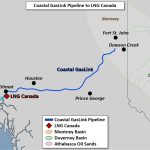
LNG Canada posted a notice on September 5 stating that: “LNG Canada is now safely receiving gas from the Coastal GasLink pipeline and low-level flaring has commenced at our export facility in Kitimat. More visible flaring will begin in the coming weeks.” This confirms our insight from last week that gas flow from the Coastal GasLink pipeline into the liquefaction site was getting underway in advance of the extensive process of testing equipment and aligns with third party satellite data showing that a heat plume from the flare stack was now detectable.
Featured Articles
- Analyst Insight
And Now It Begins – First Gas Introduced to the LNG Canada Liquefaction Plant
First gas has been introduced to the LNG Canada site for equipment testing as part of the long journey to liquefaction. If all testing goes smoothly, we expect LNG exports before the end of the year and gas intake approaching 500 MMcf/d.


- Blog
Thinking Out Loud - What Might Be the Timing and Scope of the Ramp Up of Gas into LNG Canada?
LNG Canada, under construction for nearly six years on Canada’s West Coast, is rapidly approaching the time when first gas will be entering the plant for testing and calibration of equipment, marking an important transformation for the Western Canadian natural gas market. This will kick off what will likely be about a yearlong testing process before officially entering commercial service in mid-2025. In today’s RBN blog, we consider daily gas flow data from the startup of similar-sized LNG plants on the U.S. Gulf Coast and develop a conjectural timeline for LNG Canada to help assess how much gas will flow to the site — and how soon — and when LNG exports might begin.


- Blog
Keep This Party Going - An Update on Canada's West Coast LNG Export Projects
Developers have been kicking around plans for LNG exports from British Columbia (BC), Canada’s westernmost province, for more than a decade, with more than 20 projects on the drawing board at one point. That long list has been whittled down to just three that have reached the point of final investment decision (FID) — a hard plan to proceed to construction and startup. One of those projects, LNG Canada, should be sending out LNG as soon as the end of this year, placing Canada firmly on the map of LNG-exporting nations. In today’s RBN blog, we take a closer look at the three projects and hint at plans by a handful of contenders vying to join the LNG export party.
