


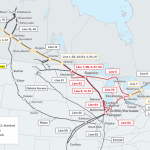
Enbridge Inc has concluded an open season to recontract up to 50 Mb/d of existing capacity on its Express Pipeline after term commitments ended. The open season began April 11 and ended May 15, and service agreements are expected to be signed by end-May. Based on past regulatory filings, committed contracts on the 310 Mb/d system could be as short as 5 years.
Featured Articles
- Analyst Insight
Enbridge Begins Open Season to Recontract 100 Mb/d of Capacity on Express Pipeline
Enbridge is holding an open season for its Express Pipeline to recontract about 100 Mb/d of transportation service originating at Hardisty, Alberta.


- Blog
Oil From the North Country, Part 2 - As More Canadian Crude Flows South, a Push to Expand Pipes
U.S. crude oil imported from Western Canada averaged almost 3.6 MMb/d in the first 10 months of 2020 and accounted for 60% of total imports over the period. That’s some growth! Ten years ago, Canada was sending less than 2 MMb/d south and contributing only 21% of total U.S, import volumes. Alberta oil sands producers are planning for more production and export growth through the 2020s, with most of the incremental volumes bound for Midwest and Gulf Coast refineries and export docks. If that happens — and there’s no certainty it will — more north-to-south pipeline capacity through the U.S. heartland will be needed. Today, we continue our series on the efforts to expand or reverse crude oil pipelines between the U.S./Canada border and the Gulf of Mexico.

- Blog
Here We Go Again - Takeaway Constraints Spur Another Round of Crude Pipeline Projects
Crude oil production in Western Canada and the Bakken is ratcheting up — in the Niobrara too — but pipeline takeaway capacity to key markets south of there is an issue. For a couple of years now, egress out of Alberta has been problematic, due in large part to delays in the development of the Enbridge Line 3 replacement, the Trans Mountain Expansion (TMX) and Keystone XL. Things got so bad last winter that Alberta’s provincial government ordered production cutbacks, though they are now easing. Rising Bakken production is quickly filling any remaining space on the Dakota Access Pipeline, and pipes out of the Niobrara’s Powder River and Denver-Julesburg (D-J) basins are approaching their capacities as well. In response, midstream companies have proposed a number of fixes, some very incremental in nature and others big and impactful. As typically happens, though, too much capacity may be on the drawing board. Today, we consider the ongoing competition to build new capacity down the eastern side of the Rockies.
