


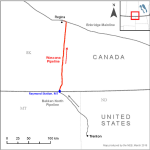
On June 5, Enbridge applied to the Canada Energy Regulator (CER) to reactivate a connection between its Mainline that transports crude oil and NGLs from Western Canada and the Plains Midstream Canada-owned and -operated Wascana Pipeline. The Wascana Pipeline (red line in map below) is 170 kilometers (~106 miles) in length connecting a receipt point at Raymond Station in Sheridan County, MT (blue dot) on the U.S./Canada border to a pipeline connection with the Enbridge Mainline at Regina, SK and has an estimated capacity of 40 Mb/d. Light crude oil from the Bakken is transported to Raymond Station from a collection point in Trenton, ND using the Plains-operated Bakken North Pipeline.
Featured Articles


- Blog
No Promises - How Will Rejection of Enbridge's Plan for Mainline Contracting Affect Crude Oil Flows?
Late last month, the Canada Energy Regulator (CER) ruled against Enbridge’s proposal to convert as much as 90% of the capacity on its multi-pipeline, 3-MMb/d Mainline crude oil system to long-term contracts. The CER’s action leaves in place the Mainline’s current capacity-allocation process, under which every barrel-per-day of the pipeline system’s capacity is open to all shipping customers on a month-to-month basis. Although the rejection of Enbridge’s proposal is unlikely to change the volume of Western Canadian crude oil flowing on the Mainline over the next few months, the longer-term outlook for Mainline flows is less certain given that other, competing pipeline capacity out of Alberta will be coming into service by late 2022 or early 2023. In today’s RBN blog, we examine the decision to reject long-term contracting and what might be the next steps for Enbridge.


- Blog
For Whom the Pipeline Tolls - Approval of Enbridge Mainline Tolls Locks In Years of Shipping Cost Certainty
The Enbridge Mainline, by far the largest transportation network for growing Western Canadian crude oil supplies to the U.S. Midwest, Gulf Coast and Eastern Canada, recently received regulatory approval for the tolls that it charges shippers for using the massive pipeline system. As we discuss in today’s RBN blog, the Canada Energy Regulator’s (CER) thumbs-up ensures another five years of shipping cost predictability and comes as the Canadian oil pipeline landscape is about to permanently change with the pending startup of the 590-Mb/d Trans Mountain Expansion Project (TMX).


- Blog
Let Your Crude Flow - Planned Feeder Pipelines to Dakota Access
The Army Corps of Engineers is said to be considering alternative routes for the most controversial segment of the Dakota Access Pipeline, which could help break the impasse that has stalled construction on that part of DAPL. If the 450-Mb/d crude oil delivery project gets back on track soon––something that no one knows for sure––an important two-part question remains: Where will the crude to fill the 450-Mb/d pipeline come from, and where will it be fed into DAPL? Today we look at the supply sources that will help fill one of the most important oil pipelines now under development.
