A Molten Industries demonstration plant that will produce battery-grade graphite from natural gas, with clean hydrogen produced as a byproduct, has begun commissioning in Oakland, CA. The company said it is the world’s first plant of its type.
Molten’s technology splits methane into carbon and hydrogen, without oxygen, combustion or carbon dioxide (CO₂). Compared with conventional synthetic graphite, Molten said its process requires cheaper feedstock and less electricity, needs no graphitization furnace, and produces zero process emissions. The Oakland plant has a capacity of 300 MT/year of graphite anode production. It did not note the amount of hydrogen that would be produced.
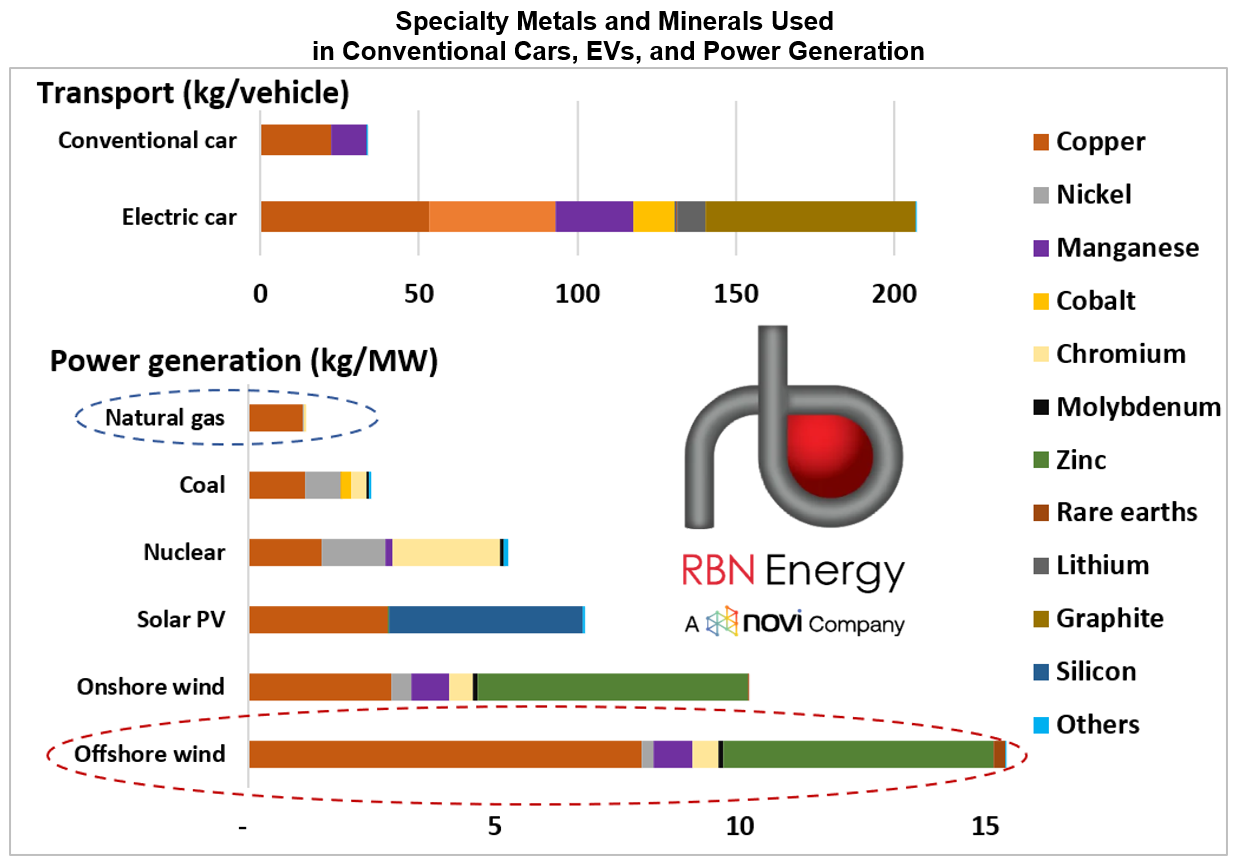
Graphite is the primary material that holds a charge in a lithium-ion battery, making it essential for EVs, data centers and other applications. As we noted in Tell It Like It Is, EVs require a lot more specialty metals and minerals, including graphite (brown bar sections in chart below), than a conventional car. For power generation (colored bars in lower part), it takes about 9X more of specialty metals and minerals per megawatt of capacity for an onshore wind project (dashed red oval) than a natural gas plant (dashed blue oval). Molten said the U.S. remains dependent on foreign sources for battery-grade graphite, with 96% of global battery graphite processing controlled by China.