


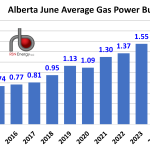
Alberta’s natural gas use for power generation (“power burn”) has averaged 1.73 Bcf/d so far in June 2025 (red column and text in chart below), a slight gain on the 1.72 Bcf/d average of June 2024, and on track for a record for the month according to data published in RBN’s Canadian NatGas Billboard. The high is a function of both strongly rising power demand in the province (total generation up 12% versus a year ago) and an increase of about 1,500 megawatts (MW) in installed gas-fired generation capacity versus a year ago. Should the record hold for the remaining days of June, it will mark the fifth month in the first six months of this year that power burn has been at a monthly record high, with May 2025 just a fraction lower (-0.002 Bcf/d) than May 2024.
Featured Articles


Life in the Fast Lane - Alberta's Gas Power Burn to Expand Significantly Next Year
In many parts of the world, the shift away from coal-fired to natural gas-fired generation and renewables has been gaining momentum in an attempt to curtail the output of carbon dioxide (CO2) and other greenhouse gases. The Canadian province of Alberta kicked off such an initiative in 2016 to eliminate all of its coal-fired power generation sources and replace these with either gas-fired plants, wind farms, or solar by 2030. In the past two years, the province’s major electric utilities and independent power producers (IPPs) have been accelerating these plans, such that the complete phase-out of coal will be accomplished many years in advance of the original deadline. Today, we consider this transition and highlight what should be a pivotal year for Alberta’s use of natural gas in power generation.
February Cold Fires Up Single Day Canadian Gas Demand Record


Get Me Out of Here, Part 3 - Prospects for Natural Gas Demand Growth in Western Canada
Growing natural gas supplies in Western Canada have been pressuring gas prices and export pipelines in the region, but there are signs that at least some of that supply-growth pressure is being offset by rising gas demand. Though the region is pegged as primarily a winter gas market — where local demand only rises when the temperature falls into the winter extremes — non-weather-related demand for natural gas has been growing in Western Canada and looks to have further upside in the years ahead. Today, we delve into Alberta and British Columbia’s gas demand trends and their potential to help balance the region’s oversupply conditions.
