
- Blog

No Particular Place To Go? Processed Condensate Volumes Slow to Export

At the end of last year the Department of Commerce Bureau of Industry and Security (BIS) issued clarifications designed to clear the way for greater U.S. exports of processed condensate. More companies have received BIS approvals to export – the latest being Plains All American last Thursday. Last year expectations were that as much as 230 Mb/d would be shipped in 2015. But narrowing price differentials have reduced the arbitrage necessary to make exports economic. Nevertheless midstream companies continue to invest in infrastructure to deliver processed condensate to marine docks. Today we review the state of the export market and ongoing infrastructure plans.


- Blog

Condensate City – Eagle Ford Crude Infrastructure Part 9 – Condensate Splitting

Kinder Morgan expect to commission the first 50 Mb/d of condensate splitter capacity at their Galena Park terminal in Houston during the next month. The capacity is leased to BP North America and will be supplied with condensate via Kinder’s Eagle Ford pipeline gathering network. Another 235 Mb/d of condensate splitter capacity could be online by 2017 – most of it in Corpus Christi. Meanwhile the jury is still out on whether it makes more sense for a producer to use a condensate splitter or to just process their condensate through a stabilizer with distillation. Either way the resulting products seem likely to end up in the export market. Today we detail the splitter plans.

- Blog

Going to a VGO? – The Intermediate Feedstock You Wish You Knew!

Vacuum gas oil or VGO is one of those mystery products talked about by refiners but barely understood by those of us that are not engineers. However it is an important intermediate feedstock that can increase the output of valuable diesel and gasoline from refineries. Lighter shale crudes such as Eagle Ford can produce VGO material direct from primary distillation. Today we shed some light on this semi-finished refinery product.

- Blog

Complex Refining 101 Distillation – No Test and No Math Guaranteed

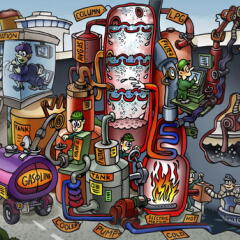
The US has more refining capacity than any other country (17MMb/d) and nowhere are refineries as sophisticated. In the past two years US refineries in the Midwest region have been running close to full capacity and refineries in the Gulf Coast region have led a refined product export boom. At the same time, refineries on the East Coast have been shuttered or saved only by a combination of last-minute deal-making and government subsidies. What makes one refinery better than another? Today we walk through the first distillation process in a complex refinery.

- Blog

Gulf Coast Diesel Crack Habit – Can Refiners Live Without it? - Part 2

Yesterday we learned that Gulf Coast diesel cracks (margins over crude) averaged $12.88/Bbl since August 2010 (read it here if you missed it). The result has been a Gulf Coast diesel-refining boom. Diesel production to feed this boom comes from refining conventional domestic and imported crude supplies that currently feed Gulf Coast refineries. Today we discover how new supplies of unconventional shale crude will force Gulf Coast refineries that process these light sweet crudes to kick their diesel crack habit.