
OPEC+ is ramping up production, WTI is hanging below $65/bbl, and Permian crude oil production growth has slowed to a crawl, raising the question of whether oil output in the U.S.’s #1 shale play might, in fact, be peaking. That’s making some folks on the NGL side of things a little skittish. They’re wondering what a leveling off — or an outright decline — in Permian crude production would mean for associated gas and the volumes of Y-grade being piped to Mont Belvieu and other fractionation hubs. In today’s RBN blog, we discuss a new model that forecasts Permian NGL production under a variety of scenarios.
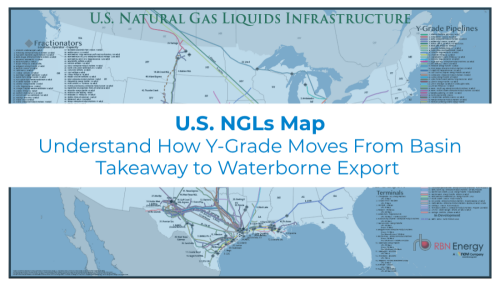
Visualize the infrastructure behind U.S. NGL movement.
The U.S. NGLs Map provides a comprehensive view of the transport, processing, and export networks moving NGLs across the U.S.
The Shale Revolution initiated a golden age for U.S. NGLs. Sure, domestic crude oil production has increased by more than 160% since 2008 and natural gas output has nearly doubled, but the volume of mixed NGLs (aka Y-grade) produced at U.S. gas processing plants has quadrupled, from 1.8 MMb/d 17 years ago to 7.3 MMb/d today. And that massive gain in NGL production spurred an unprecedented buildout in NGL-related infrastructure — processing plants, of course, but also Y-grade pipelines, salt-cavern storage capacity, fractionators and NGL export terminals. (See our Drill Down Report on this topic for a summary and our recent Don’t Stop blog series and weekly NATGAS Permian report for updates.)
Here’s another important fact: The Permian is the undisputed king of NGL production, accounting for more than 40% (or about 3 MMb/d; blue layer in left graph in Figure 1 below) of the total NGL volumes produced in the U.S. Not only does crude-oil-focused drilling in West Texas and southeastern New Mexico generate vast amounts of NGL-saturated associated gas, but over time the Permian’s gas-to-oil ratio (GOR) has been increasing (middle graph). And so has the Permian’s gallons-per-Mcf (GPM) number, which measures the gallons of mixed NGLs entrained with each thousand cubic feet of associated gas emerging from wells there (right graph).
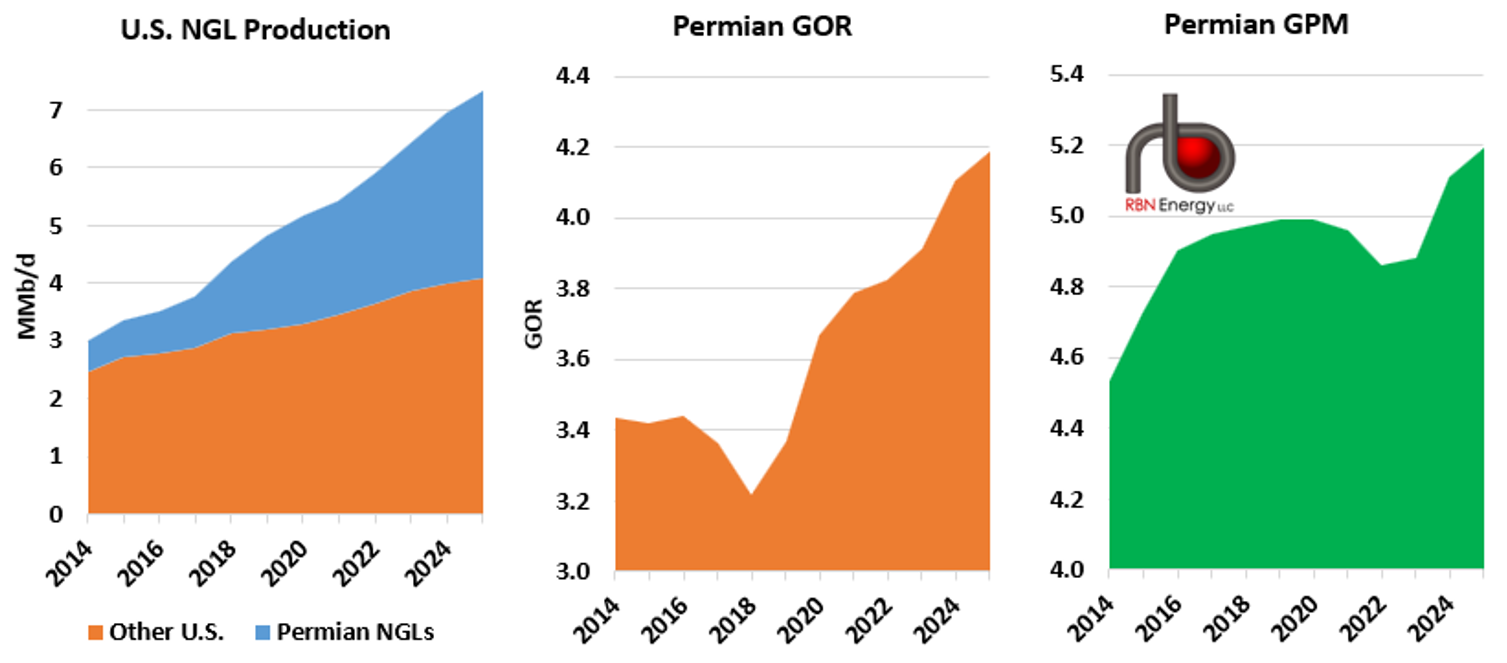
Figure 1. Permian NGL Production, Gas-to-Oil Ratio and Gallons-per-Mcf. Source: RBN
As you would expect, a wide range of market players are counting on continued growth in Permian NGL production, including the owners and operators of gas processing plants, NGL pipelines, fractionators, and ethane and LPG export terminals, many of which continue to make big-dollar investments in new infrastructure. And, as we at RBN know firsthand, some of these same companies have been expressing concern that the production growth they’ve been banking on may be undermined by less favorable WTI pricing and a prospective slowdown in Permian drilling-and-completion activity.

About the song
“Don't Worry, Be Happy” was written by Bobby McFerrin and appears as the first song on side one of Bobby McFerrin’s fourth studio album, Simple Pleasures. Released as the first single from the album in July 1988, it went to #1 on the Billboard Hot 100 Singles charts and has been certified Gold by the Recording Industry Association of America (RIAA). It was the first a cappella song to achieve that status. The song was prominently featured in the motion picture Cocktail, which was released at the same time as the single. It won awards for Song of the Year, Best Male Pop Vocal Performance, and Record of the Year at the 1989 Grammy Awards. Personnel on the record? Well, just Bobby McFerrin (all vocals).
Simple Pleasures was recorded at Power Station in New York City and Fantasy in Berkeley, CA, in 1987-88. Produced by Linda Goldstein and Bobby McFerrin, the album was released in March 1988 and went to #5 on the Billboard 200 Albums chart. It has been certified Platinum by the RIAA. The album featured all a cappella performances by McFerrin. One single was released from the LP.
Bobby McFerrin is an American singer, songwriter and composer. He usually performs as an unaccompanied vocal artist. His first studio album, Bobby McFerrin, was released in 1982. He has released 14 studio albums and six singles. He has sold more than 20 million records worldwide. McFarrin was diagnosed with Parkinson's disease in 2023. He just completed a series of concerts on Monday nights at the Freight & Salvage nightclub in Berkeley in July. McFerrin resides in San Francisco.