In the global crude oil market, at least some degree of coordinated management of supply has been the norm since the end of World War II. From the mid-1940s to the early 1970s, the cabal of oil companies known as the Seven Sisters jointly managed production to keep crude prices at levels that accommodated their interests. Then it was OPEC’s turn. More recently, the efforts to keep supply from overwhelming demand — and help prevent oil prices from crashing — have been led by a combination of OPEC and some other major producers, including Russia. U.S. shale producers — who’ve contributed significantly to the global supply growth in recent years — have both benefited from this supply management and partially thwarted it by continuing to increase production to offset cuts by “OPEC-Plus.” But a projected slowdown in U.S. production growth in 2021 may change these market dynamics. Today, we begin a short blog series on global oil supply and demand trends, supply management efforts by OPEC-Plus, and what it all means for OPEC, U.S. producers and the broader oil market.

In many ways, the U.S. energy sector in 2020 is the picture of unbridled competition. Producers, midstreamers and traders all are working day in, day out to gain an edge over their rivals. In the global market, however, there’s been a long history of efforts to manage the supply of crude oil, in particular, to help ensure a supply-demand balance that optimizes suppliers’ profits. During the rare lapses in supply management in the 75-year-long post-war era, crude oil prices have tended to plunge to levels discouraging to producers and intoxicating to consumers — a formula for price gyrations and market chaos that is helpful to almost no one. The last such episode started in the latter half of 2014, when Saudi Arabia, OPEC’s leader, refused to orchestrate supply restraint in response to a crude price slide that had begun at mid-year, as growing non-OPEC production pushed global supply beyond consumption, raising inventories. The non-OPEC production gains at the time were largely from the U.S., where shale production was expanding rapidly, as well as from Canada, mostly the oil sands of Alberta. With global supply growth outpacing growth in demand, the price of spot Brent crude peaked just above $115/bbl in June 2014 and slid to $77-79/bbl in the fall. When Saudi officials made clear they had no intention of leading production cuts that were sure to be offset by increases elsewhere (a topic we covered in our blog Crying Time At OPEC?), the spot Brent price then skidded toward an abyss of $26/bbl in January 2016.
However, reeling financially along with other producers — if not quite as dreadfully — the Saudis eventually reversed their position and began discussing a reinstatement of supply management. As we noted in Is This The Real Life? Is This Just Fantasy?, the product of that effort took effect at the start of 2017, when 11 out of 13 OPEC members and 11 non-member producing countries, one of which later joined OPEC, began implementing cuts totaling nearly 1.8 MMb/d from baseline levels of the preceding October. (Two other cuts in production followed: a 1.2-MMb/d reduction on January 1, 2019, and another 500 Mb/d on January 1, 2020. Reducing supply from the 22 OPEC-Plus countries had the intended effect of supporting global oil prices, which have remained within the $50-to-$70/bbl range for most of the past three-plus years. But, as expected, OPEC members’ market share fell from 35% in 2015 and 2016 to 32% in 2018, and down to 30% last year (dark brown layer in left graph in Figure 1), as the share held by non-OPEC producers (light brown layer) — or, more specifically, non-OPEC producers like the U.S., Canada, Brazil and Norway that were not parties to the supply-management agreements — increased. (The right graph shows that demand has remained flat among the industrialized free-market countries that make up the Organization for Economic Cooperation and Development, or OECD, but increased in non-OECD countries such as China and India.)

About the song
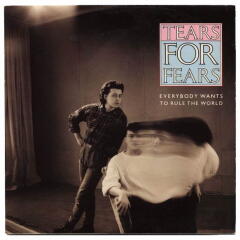
"Everybody Wants to Rule the World" was written by Roland Orzabal, Ian Stanley and Chris Hughes. It appears as the third song on side one of Tears for Fears second studio album, Songs from the Big Chair. Released as a single in March 1985, the song went to #1 on the Billboard Hot 100 Singles and Hot Dance Club Play charts. Personnel on the record were: Roland Orzabal (guitar, keyboards, vocals), Curt Smith (bass, lead vocals), Ian Stanley (keyboards, Linn Drum programming, Oberheim DMX), Manny Elias (drums, Oberheim DMX), Neil Taylor (second guitar solo) and Chris Hughes (drums, Oberheim DMX, MIDI programming).
Songs from the Big Chair was recorded during 1984 at The Wool Hall in Beckington, England, with Chris Hughes producing. The album yielded two #1 singles, "Everybody Wants to Rule the World" and "Shout." Songs from the Big Chair went to #1 on the Billboard Top 200 Albums chart. It has been certified 5x Platinum by the Recording Industry Association of America.
Tears for Fears are an English new wave pop group formed in Bath, England, in 1981 by Roland Orzabal and Curt Smith. They have released six studio albums, one live album, three compilation albums, one EP and 35 singles. Orzabal and Smith went their separate ways in 1991, with Orzabal keeping the rights to the Tears for Fears name. He went on to build a new band with new members, and released two albums that were more guitar-driven. Smith patched things up with Orzabal in 2000, and they have been working together since that time. Tears for Fears still tours occasionally.