


Newfield Exploration - the largest crude oil producer in Utah’s Uinta basin - has temporarily suspended new drilling operations there in response to lower prices. Other producers in the region have reduced their drilling and capex budgets as well. The cutbacks stem in part from the extra logistics expense required to deliver and process the thick yellow and black “waxy” Uinta crudes that do not flow at room temperature. Today we describe how low prices are impacting Uinta basin production.
The Uinta Basin (pronounced you-IN-tah, sometimes spelled Uintah) located about 150 miles southeast of Salt Lake City in Northeast Utah, has produced crude oil since the 1950’s. As we previously described back in 2013, the strange looking yellow and black waxy crudes produced from the Uinta Basin resemble shoe polish at room temperature (see Do Ya Think I’m Waxy?). Since 2011 the basin has attracted a lot of producer interest with crude output increasing from new horizontal drilling as well as the use of enhanced recovery on older wells through water flooding. Production stood at about 50 Mb/d in January 2011 but has more than doubled since then to 110 Mb/d by the end of 2014 (source: Bentek). Granted that expansion pales beside the nearby Bakken crude boom that saw output jump threefold from 400 Mb/d to 1300 Mb/d over the same period, but it is significant when you consider the logistical challenges faced by producers to get their Uinta waxy crude to market and processing it. Those challenges arise from the fact that Uinta waxy crude does not flow unless it is heated and unlike Canadian bitumen, can’t be diluted using light hydrocarbons as diluent (see It’s a Bitumen Oil – Does it Go Too Far?). Waxy crude also requires specialized refinery configuration to handle its high paraffin content that few refiners outside Utah have developed. As a result, these crudes have traditionally been consumed close by at Salt Lake City refineries – delivered heated in special insulated trucks - placing a firm ceiling on production based on how much waxy crude those refineries can process.
Uinta waxy crude started to appear more attractive to local refiners and to midstream companies planning to ship the crude further afield when its price became heavily discounted along with other land-locked U.S. crudes in 2011. A crude logjam in the Midcontinent was caused by rising shale production outpacing pipeline capacity - leading to big discounts averaging $18/Bbl in 2012 for domestic benchmark West Texas Intermediate (WTI) versus crudes at coastal locations priced against international benchmark Brent (see Are They Never Ever Getting Back Together Again?). On top of the WTI discount to Brent, Uinta crudes were already sold at a discount to WTI based on quality differences and the “waxy” transport challenge (see Uinta Basin Crude Price Discounting). In effect prices for Uinta grades versus crude sold on the East, West or Gulf Coasts in 2012 were discounted by up to $40/Bbl and that provided a hefty incentive to figure out alternative routes to market and new ways to process more Uinta crude (see Alternate Routes To Market).
Locally in Utah, one result was a number of projects to expand Salt Lake City refining capacity to process more waxy crude and even green field projects to build new refineries in the State. In addition to the very cheap price of Uinta crude, area refiners were encouraged to expand by growing local demand for refined products. We described that growing demand and the Rockies regional refining market along with proposed expansions to existing Salt Lake City refineries in our “Rocky Mountain High” series in July 2014. Since then both Tesoro and Holly Frontier have each completed upgrades to their Salt Lake City refineries that increased waxy crude throughput by 15 Mb/d or so – consuming another 30 Mb/d of Uinta production. In addition Chevron upgraded their area refinery to process about 5 Mb/d more waxy crude. New refinery projects touted in Utah to process waxy crude included the Uintah Resources Gateway upgrader project (that would part-refine waxy crude to make it easier to transport) and a green field 15 Mb/d conventional refinery in Emory County, UT known as the Green River refinery (purchased in May 2014 by Bakken Energy Corp). Neither of these projects has advanced much since initial announcements in 2013 as far as we can tell.
Aside from local refining – lower Uinta crude prices in Utah provided incentives for producers and midstream companies to figure out how to transport waxy crude over longer distances to coastal markets where it could potentially be sold at a premium. To that end a number of crude-by-rail terminal projects were started in 2013 that involved loading Uinta crude onto specialized coiled and insulated rail tank cars and transporting it to refineries at East and West Coast destinations (see map in Figure #1). The same insulated tank cars are used in Canada to transport heavy bitumen crude (see Heat It! Bitumen by Rail) and work just as well for waxy crude because they can be heated with steam at the destination terminal so that the crude can flow out. Smaller rail terminals could be adapted to transload Uinta crude directly into rail cars from the insulated trucks that already deliver waxy crude to Salt Lake City refineries. And that is how most of the Uinta rail load projects started out - as transload operations loading a few tank cars to make up manifest loads. At least one of these terminals, owned by Global One Transport and operated by Watco at Price, UT is able to load 15 Mb/d of waxy crude and shipped its first unit train (100 rail cars) in February 2014. The largest Uinta producer, Newfield Exploration experimented with shipping waxy crude by insulated truck 175 miles to the Ogden terminal north of Salt Lake City on the Union Pacific railroad, from where it could be shipped to East Coast refineries. According to data from the California Energy Commission, an average of about 4 Mb/d of crude from Utah was shipped by rail to California during the second half of 2014. Tesoro has said it is processing about 5 Mb/d of waxy crude at it’s Anacortes, WA refinery – presumably shipped there by rail.
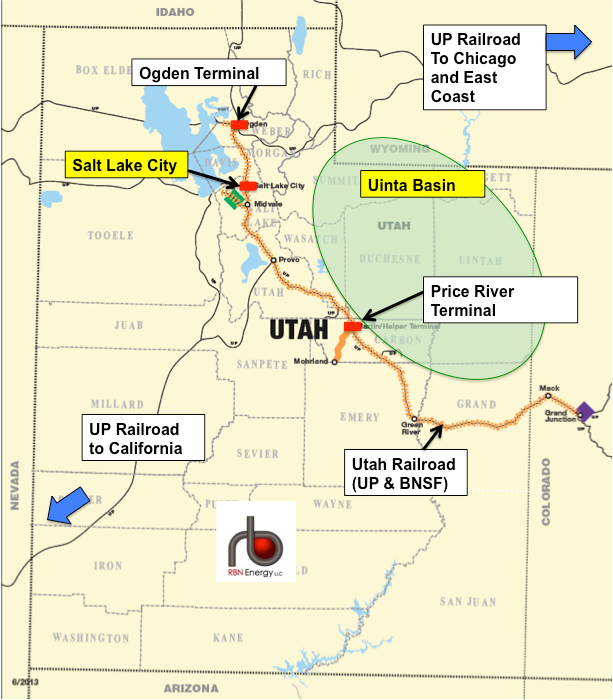
Figure #1 Source: RBN Energy

About the song
“Do Ya Think I’m Sexy” from the Blondes Have More Fun album was a hit for Rod Stewart in 1979







Comments
Your article was pretty accurate, however you stated that the yellow wax and black wax cannot be mixed with diluent. That is incorrect. For many years this crude was trucked to and shipped on a Chevron Pipeline that ran from Rangely Colorado, to SLC, and it was a heated line. After having problems and the additional cost of heating, the pipeline dropped the heated service. Afterwards, to ship yellow, you had to provide diluent at Rangely, with Rangely crude oil. .
I'm not familiar with the current situation, but I suspect the Rangely crude oil production volume has dropped and the SLC refiners buy all of the Rangely crude oil for neat delivery to SLC, and there is not enough left for diluent. The SLC refiners really drive the segregations and shipping on the Chevron pipeline, since they are the only destination.
the reason there is no diluent being used in the field is the cost to get the diluent to the production areas now. There are not the economies of scale or need to bring in the diluent with the current production.
The crude crude actually has a very good refining value to most refiners, as long as the Uinta volume is not a large % of your total crude oil runs. So actually bringing it in neat in a rail car will have a higher value to a refiner, than having it blended with some lower value diluent.
As you mentioned in the story, the main issue with the crude oil is the handling because of the viscosity.