Could it get any worse? Possibly, but the last time we saw petchem margins this bad was in the depths of the 2008-09 economic meltdown, and back then the atrocious margin levels resulted in drastic plant curtailments and in some cases permanent shutdowns. But this time around the petchem industry is in the process of bringing on even more capacity! Is the current situation a fluke, or a harbinger of things to come? In today’s blog we examine recent trends in steam cracker margins, by far the largest demand sector for natural gas liquids (NGLs) and consider what these developments may mean for NGL markets in general, and ethane in particular.
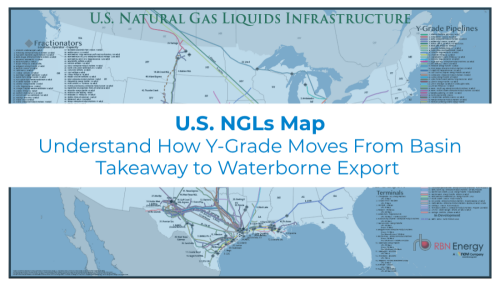
Visualize the infrastructure behind U.S. NGL movement.
The U.S. NGLs Map provides a comprehensive view of the transport, processing, and export networks moving NGLs across the U.S.
Petrochemical markets are a frequent topic here in the RBN blogosphere, almost always in the context of steam cracker feedstocks, with NGLs making up about 95% of those feedstock barrels. Or, looked at from the other end of the pipe, these plants make up about 60% of total domestic NGL demand, and 100% of domestic liquid ethane demand. So it is always a good thing — for both the petchems and producers of NGLs — when petchem margins are high. When the petrochemical industry makes money, they buy a lot of feedstocks, supporting NGL prices (and, with that, NGL producers). We recently looked at ethane margins in Ethane Asylum Revisited, where we considered the expected price impact from several new ethane-only crackers coming online, and covered new NGL supplies from “wet” shale gas production in Bring It On. Basically, the story has been that demand is increasing, but so is supply. So you’d think that petchem margins might be under some pressure, but no catastrophic collapse would be in the offing.
Yet, as shown in Figure 1, collapse is just what we have. The graphs show the cents-per-pound margins for producing a pound of ethylene from each of the major feedstocks used by U.S. steam crackers, adjusted for the value of byproduct credits — that is, the value of other petrochemicals produced when each feedstock is “cracked.” (For a more in-depth discussion on calculating margins for producing ethylene, see Let’s Get Cracking – How Petrochemicals Set NGL Prices.)

About the song
"Good Lovin' Gone Bad" was the first single from Bad Company's second album, 1975's Straight Shooter. The song was written by the band’s lead guitarist, Mick Ralphs, and was recorded in September 1974. It was released as a single in March 1975, and rose to #31 in the UK and #36 on the U.S. charts. Straight Shooter would go platinum in sales in 1975.
Bad Company was put together in London in 1973 by ex-Free members Paul Rodgers (vocals, guitar and keyboards) and Simon Kirke (drums). Mick Ralphs, from Mott the Hoople, joined them as lead guitarist, with Boz Burrell from King Crimson on bass. The band was managed by Led Zeppelin's manager, Peter Grant. This line up stayed the same, with good success until 1980, when Grant, heartbroken and discouraged by the death of Led Zeppelin's drummer John Bonham, retired from the management business. After that, various members came and went in the band. Rodgers and Kirke, supplemented by various band members, continue to periodically tour as Bad Company to this day.