There is a natural gas renaissance of sorts happening south of the U.S.-Mexico border. The state-owned Comisión Federal de Electricidad (CFE) is investing heavily in expanding and modernizing its power generation fleet with thousands of megawatts of new, natural gas-fired power plants, and the energy secretary also last October put forth an aggressive five-year plan to build out a pipeline system to supply growing gas-fired generation demand. Mexico’s power generation demand is increasingly a target for U.S. gas producers and pipeline projects. At the same time, as we discuss in Part 2 of RBN’s Miles and Miles of Texas Drill-Down Report published last week, a good portion of this new demand is relying on — and in large part has been driven by — availability of low-priced gas from the U.S. via Texas and the U.S. Southwest states. But there is a lot that needs to happen on both sides of the border over the next few years to facilitate this mutually beneficial relationship. Already since October, Mexico’s newly appointed independent pipeline operator, Centro Nacional de Control del Gas Natural (CENAGAS), has pulled back on the pipeline buildout. Today, we begin a two-part series on how plans to facilitate this new demand are progressing, starting on the Mexico side of things.
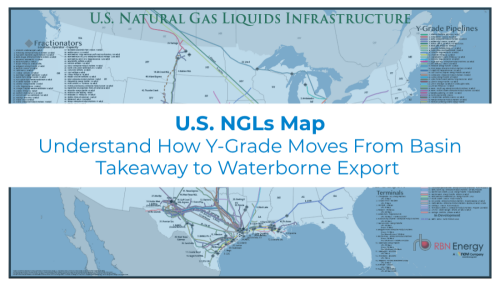
Visualize the infrastructure behind U.S. NGL movement.
The U.S. NGLs Map provides a comprehensive view of the transport, processing, and export networks moving NGLs across the U.S.
Mexico has been rapidly converting from a net energy exporter to the U.S. (mostly in the form of crude oil) into a country that exports a lot less crude to the U.S. and imports a lot of natural gas — and quite a bit of transportation fuel and liquefied petroleum gas (LPG) as well. Natural gas production in Mexico (blue line in Figure 1 below — MMpcd translates to MMcf/d) has slipped and stagnated, falling from well over 6.0 Bcf/d in 2010 to little more than 5.5 Bcf/d in the first eight months of 2015, according to Mexico’s Secretaría de Energía (SENER), even as demand for gas within the country has climbed (green line). With domestic natural gas production in decline and demand on the rise, Mexico’s natural gas imports from the U.S have tripled over the past five years: from just over 1.0 Bcf/d in June 2010 to nearly 3.6 Bcf/d in July 2016, according to data from the U.S.’s Energy Information Administration (EIA). New natural gas export pipelines have come online over the past two years and another half dozen new pipeline projects are being built into Mexico via Texas natural gas supply corridors (we’ll get to this in Part 2 of this series).

About the song
"It Takes Two" was recorded as a duet in late 1965 by Marvin Gaye and Kim Weston in 1966. The song peaked at #14 on the Billboard Pop charts and #4 on Billboard′s Soul Singles chart in January 1967. A completely different song of the same name was done by New York Hip house artists Rob Base and DJ E-Z Rock that became a top 40 hit single.