Crude-oil-focused wells in the Permian generate massive volumes of produced water, and E&Ps have made tremendous strides in dealing with it. Most important, a growing share of that water is being recycled for use in new well completions. But challenges remain. Deep disposal wells — a popular option for handling produced water — can spur seismic events, and shallow disposal wells can do the same and also negatively impact oil well integrity. As we discuss in today’s RBN blog, Permian E&Ps are taking an increasingly comprehensive, holistic approach to produced water management.
Produced water — that is, the briny, minerals-packed water that emerges from Permian and other wells with crude oil and associated gas — has been a frequent blog topic. As we said in our Wipe Out! blog series a few years back, in the olden days (before the Shale Era), E&Ps often dealt with produced water from old-school vertical wells by simply pumping it back into the same formation that it came from. That approach made the water disposal problem go away, and sometimes it actually improved well performance –– that additional water increased pressure at the bottom of the well and drove more oil into the well bore and up to the surface, hence initiating some of the first enhanced oil recovery (EOR) techniques.

The replay of our Fall 2026 School of Energy (September 9 & 10, Houston) is now available online!
Learn from RBN experts, participate in hands-on Excel modeling, connect with industry peers, and gain a stronger understanding of today's interconnected energy markets.
But then shale happened. Horizontal drilling and hydraulic fracturing opens up previously impermeable rock for oil and associated gas (and produced water) to flow out — but not for produced water to flow back in. Instead, the produced water needs to be collected and dealt with. Through the first half of the 2010s, the volumes were relatively modest and were usually hauled off the lease in trucks to injection sites where it was pumped down deep, Class II “salt water disposal” wells (aka SWDs) drilled specifically for that purpose. As Permian production increased sharply later in the 2010s, so did produced water volumes. E&Ps and a handful of companies specializing in water-related infrastructure development and operation built out produced water gathering systems — pipelines that transported produced water from the lease to SWDs or (to a lesser extent at first) produced water recycling plants or specially built ponds where the water was left to evaporate. (See our Splish Splash blog series for more.)
A lot has happened since then — things that in total have taken the produced water part of the Permian production machine to a whole new level.
Before we dive into this, we should explain why we’re focusing on the Permian. To paraphrase Willie Sutton — who, when asked by a reporter why he robbed banks, replied “Because that’s where the money is” — the Permian is “where the produced water is.” As shown in Figure 1 below, crude-focused wells in West Texas and southeastern New Mexico (blue bars) account for the vast majority of the produced water generated in the leading U.S. shale plays. And produced water volumes in the Permian have been rising fast, from less than 8 MMb/d in 2017 to about 20 MMb/d this year to an estimated 24 MMb/d in 2030 — all according to our friends at B3 Insight. Those are extraordinary volumes — about 3.2 barrels of produced water for every barrel of crude, on average. And in some parts of the Permian the produced-water-to-crude ratio is as high as 12 to 1!
Produced Water Volumes by Shale Play, 2017-30
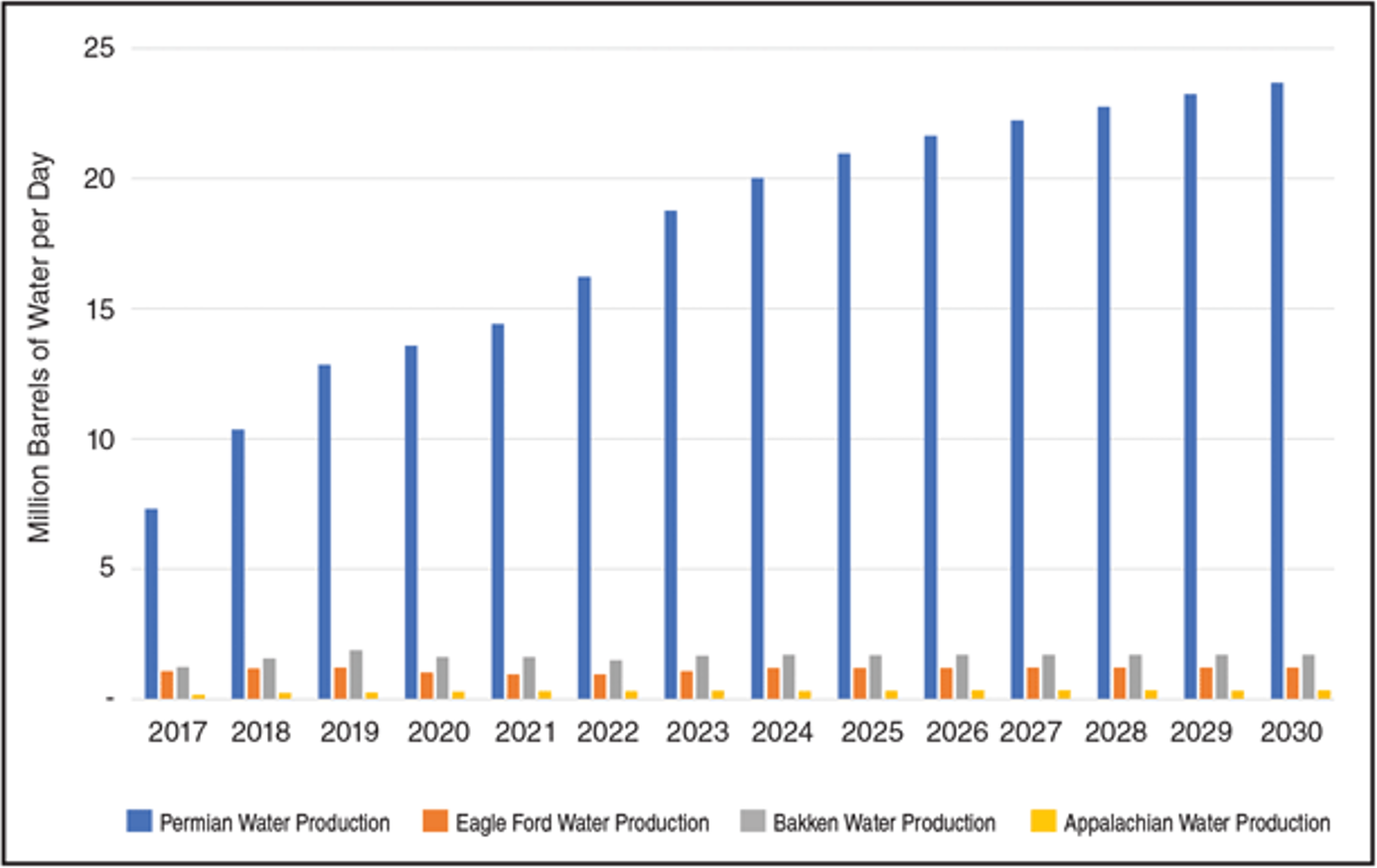
Figure 1. Produced Water Volumes by Shale Play, 2017-30. Source: B3 Insight

About the song
“Coming Around Again” was written by Carly Simon and first appeared in the end credits of the 1986 motion picture Heartburn. It later appeared as the first song on side one of Carly Simon’s 13th studio album, Coming Around Again. Released as a single in October 1986, it went to #5 on the Billboard Adult Contemporary chart and #18 on the Billboard Hot 100 Singles chart. The success of the single started a career resurgence for Simon, who was known for her hit singles in the 1970s. The song is included in multiple compilations of her work. Personnel on the record were: Carly Simon (lead, backing vocals, keyboards), Scott Martin (keyboards, backing vocals), Bill Payne (keyboards), Russ Kunkel (drums), and Paul Samwell-Smith and Terri Homberg (backing vocals).
The album, Coming Around Again, was recorded in 1986-87 at Right Track Recording, The Power Station, PinWheel Studio, Unique Recording Studios and Flying Monkey in New York City and Cliffhanger Studio in Vancouver. Produced by Clive Davis, Bryan Adams, John Boylan, Frank Filipetti, Russ Kunkel, George Massenburg, Rob Mounsey, Bill Payne, Richard Perry and Paul Samwell-Smith, the LP was released in April 1987. It went to #25 on the Billboard 200 Albums chart and has been certified Platinum by the Recording Industry Association of America. A cast of 42 (including Simon) musicians and 10 producers contributed to the album. Four singles were released from the LP.
Carly Simon is an American singer, songwriter, musician and author. Her father was Richard Simon, who co-founded the publishing house Simon & Schuster. In the 1970s Carly Simon had 13 Top 40 hits. Her professional career started in 1963 when she began performing with her sister Lucy as The Simon Sisters. Their 1964 Kapp Records debut album, Meet the Simon Sisters, reached #73 on the Billboard 200 Albums chart. Her first solo album was the highly successful 1971 release, Carly Simon. That album won her a Grammy Award for Best New Artist. She has released 23 studio albums, two live albums, 10 compilation albums, one soundtrack album and 41 singles. She has authored two memoirs and five children‘s books and has won an Academy Award, a Golden Globe Award and two Grammy Awards. Simon is a member of the Rock and Roll Hall of Fame, Songwriters Hall of Fame, and has a star on the Hollywood Walk of Fame. She continues to record and do occasional public appearances. Her last concert appearance was in 2018 at Carnegie Hall.