There has been growing concern regarding NGL pipeline takeaway capacity out of the Williston Basin and the Niobrara — particularly the DJ Basin — over the past year, with one of the major pipes through those regions now running full. Finally, ONEOK has announced plans for the Elk Creek Pipeline, which will have an initial capacity of 240 Mb/d and be expandable to 400 Mb/d. The new pipe will transport mixed, unfractionated NGLs from eastern Montana to the Conway/Bushton fractionation hub in central Kansas, and provide long-term relief for a lot of Bakken, Powder River and Denver-Julesburg (DJ) Basin producers. But with an end-of-2019 in-service date, will the new capacity come soon enough to avert NGL takeaway constraints? Today, we discuss the Elk Creek project, the flows on existing NGL pipes to Conway/Bushton, and the growing significance of ethane as pipelines fill.
It has been a while since we blogged about Bakken and Rockies NGL pipeline takeaway capacity. Back in December 2015, we published the first of our Spotlight reports (a joint venture between RBN and East Daley Capital Advisors) and discussed the report’s highlights in No Sleep Till Bushton – Strong Fundamentals Position ONEOK To Leverage Bakken Assets. And way back in 2013, we wrote The Race Is On And It Looks Like ONEOK – Bakken NGLs Production Growth, when ONEOK announced completion of the initial phase of the Bakken NGL Pipeline.
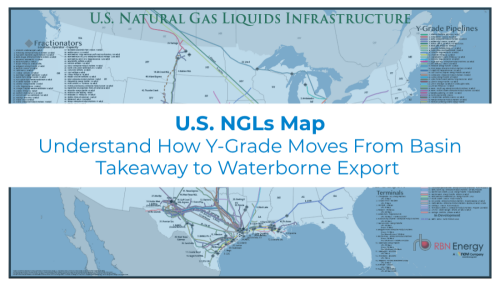
Visualize the infrastructure behind U.S. NGL movement.
The U.S. NGLs Map provides a comprehensive view of the transport, processing, and export networks moving NGLs across the U.S.
Before getting into the potential takeaway issues that might occur between now and late 2019 when ONEOK’s new Elk Creek Pipeline is due to come into service (and possible solutions to handle those issues), let’s look at the project itself, and some of the existing NGL pipes in the broader region. Elk Creek will be an approximately 900-mile, 20-inch-diameter pipeline that will originate near the company's Riverview terminal in Richland County, MT, run south through the eastern edges of Montana and Wyoming, then cut across the northeastern corner of Colorado on its way to Bushton, KS (dashed green line in Figure 1). Initially, it will have the capacity to transport up to 240 Mb/d of unfractionated NGLs, but with additional pump facilities the capacity could be expanded to 400 Mb/d. The pipeline is anchored by long-term contracts (terms ranging from 10 to 15 years) totaling about 100 Mb/d (primarily minimum volume commitments, or MVCs).
About the song
"Thank You" is a song by the English rock band Led Zeppelin from their 1969 album, Led Zeppelin II. The song was written by Jimmy Page and Robert Plant, and is the first Zeppelin song for which Plant wrote all the lyrics. (It was written about his then-wife Maureen.) The song was produced by Page, with Eddie Kramer engineering. Jimmy Page has been quoted as saying his concept for Led Zeppelin was to have "lots of light and shade in the music," and that concept is exemplified perfectly in "Thank You," with its melodic vocals, haunting Hammond organ, thunderous drums, and delicately weaved six- and 12-string guitars.
All of the Led Zeppelin II album was written and recorded on the fly at several studios in the U.S., Canada, and England while the band was touring from January through August in 1969. It was Led Zeppelin's first #1 album, and remained at #1 on the U.S. charts for seven weeks. It has gone platinum (one million in sales) 12 times.
Led Zeppelin was formed in London in 1968 by Jimmy Page. Page had been an in-demand session guitarist in London when his friend Jeff Beck convinced him to join The Yardbirds as a bassist to break the monotony of session work. After one tour and the departure of Jeff Beck, Page ended up being the sole guitarist in The Yardbirds until its demise in 1968. Page, hot on the idea of forming a new band, originally wanted Terry Reid as the vocalist, but Reid had just signed a solo record deal and passed. He recommended Robert Plant, who got the gig. Plant had played in a group with John Bonham, and brought him into the fold as drummer. Jimmy knew bassist John Paul Jones from the session circuit in London and brought him aboard too. When all four members jammed together on the tune "Train Kept A Rollin" at a rehearsal hall in London, Page knew he had found the lineup he was looking for. Led Zeppelin went on to conquer the world and the music business from 1968 until 1980, when, after the death of drummer John Bonham, they decided to call it a day.
Led Zeppelin was inducted into the Rock and Roll Hall of Fame in 1995. To date, they have sold 300 million albums worldwide.