Appalachia natural gas producers hoping to get a big boost in pipeline takeaway capacity later this year were dealt some bad news recently. On May 4, Equitrans Midstream officially pushed back the in-service date for the already-delayed Mountain Valley Pipeline. The 2-Bcf/d, greenfield project is the last of the major planned expansions that would add substantial capacity from the prolific Appalachia gas-producing region and help stave off severe seasonal pipeline constraints, at least in the near- to midterm. Previous guidance had it coming online late this year, but Equitrans said it is now targeting start-up in the summer of 2022, pending water and wetland crossing permit reviews. The news is far from surprising considering the numerous regulatory and legal challenges midstream projects, including MVP, have previously faced in the Northeast over the past decade or so. But the resulting uncertainty leaves Northeast producers in a tight spot. In today’s blog, we will consider the implications of the MVP delay for Appalachia’s outflows.
Even prior to this latest MVP setback, we have been sounding the alarm about worsening pipeline takeaway constraints for gas supply leaving Appalachia in our Headed for Heartbreak blog series. Appalachian producers have long battled with the precarious balance between Marcellus/Utica gas supply and the pipeline capacity to get it to market and the resulting pressure on prices. For a while, things were looking better. Capacity additions in the 2018-19 timeframe had outpaced production growth, easing constraints. But as we’ve been hammering on in the ‘Heartbreak’ blogs, capacity tightened up again in 2020, in part due to an outage on Texas Eastern Transmission (TETCO), but also due to production growth. And, what’s more, it’s likely to remain tight and become further constrained over the next several years, just seasonally at first and eventually also year-round.
That was our assessment even with MVP expected to come online later this year. However, 2 Bcf/d is a significant chunk of incremental capacity, and a 2021 start-up would have gone a long way toward reducing the seasonal constraints in the midterm and keeping Appalachian gas supply prices from collapsing in the process, potentially as early as this fall or by next spring. So, understandably, all eyes have been on the prospects and timing for MVP crossing the finish line. The recently announced delay means that pressure will continue to build through the fall of 2021 and now, into the spring 2022 shoulder season as well.

The NATGAS Appalachia weekly report provides the data and insights to monitor the northeast natural gas market’s twists and turns and identify the risks and opportunities along the way, including tracking supply-demand trends, outbound capacity and their impact on takeaway pipeline utilization, and regional prices.
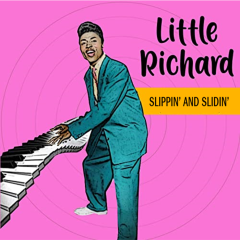
About the song
"Slippin' and Slidin'" was written by Richard Penniman (Little Richard), Edwin Bocage, Al Collins, and James Smith. The song appeared as the sixth cut on side one of Little Richard's debut album, Here's Little Richard. Recorded in February 1956, the song became the B-side to Little Richard's #1 R&B single, "Long Tall Sally,” which was released in March 1956. Many artists have covered the song over the years. Personnel on the record were: Little Richard (vocals, piano), Lee Allen (tenor sax), Alvin "Red" Tyler (baritone sax), Frank Fields (bass), Earl Palmer (drums), and Edgar Blanchard (guitar).
Here's Little Richard was recorded between September 1955 and October 1956. It contained several songs that were hit singles for Little Richard prior to the album's release. Nine of the LP’s 12 songs made the Billboard Hot 100 Singles chart between 1955 and 1957. Produced by Bumps Blackwell, the album was released in March 1957 and went to #13 on the Billboard Pop Albums chart.
Little Richard (Richard Wayne Penniman) was an American rock and roll singer, musician, and songwriter. For seven decades, Richard played rock and roll, of which he was one of the originators and architects. In 1947, Sister Rosetta Tharpe heard Richard singing in the auditorium before one of her shows. She was so impressed that she invited the then 14-year-old to open the show for her. She paid him some money for his performance and started him on the road to being a professional musician. Richard went on to influence an array of artists over the span of his career, such as James Brown, Paul McCartney, Jimi Hendrix, Bon Scott, John Fogerty, and Michael Jackson. He released 15 studio albums, three live albums, 11 compilation albums, and 37 singles. He is a member of the Rock and Roll Hall of Fame, Songwriters Hall of Fame, Blues Hall of Fame, and Rhythm and Blues Hall of Fame. He has a Grammy Lifetime Achievement Award and a star on the Hollywood Walk of Fame. Little Richard died in May 2020 at the age of 87.