Houston and Corpus Christi have been locked in a battle for the top spot as the primary outlet for Permian crude. Lately, the pendulum has been swinging toward Corpus — and not by accident — as most major new or expanded Permian pipelines in recent years have pointed straight there. In today’s RBN blog, we’ll discuss the significant shifts that have reshaped the market along the South Texas coast, sending crude to Corpus and Nederland, and preview our latest Drill Down Report.
In observance of today’s holiday, we’ve given our writers a break and are revisiting a recently published blog on Permian pipelines. If you didn’t read it then, this is your opportunity to see what you missed! Merry Christmas!
First, let’s offer up some background. There’s been fierce competition between Houston and Corpus Christi for Permian barrels for some time; Corpus took a tiny lead earlier this year and the two destinations — which together handle about 75% of Permian output — are in a dead heat. Through June, roughly 2.45 MMb/d of Permian crude had flowed to Corpus in 2025, just ahead of the 2.44 MMb/d headed to Houston, according to RBN’s Crude Oil Permian report, with about 860 Mb/d destined for Nederland. And the pipelines feeding Corpus — Cactus I, Cactus II, Gray Oak and EPIC Crude — have in total been cranking above 90% utilization almost every month since late 2022.
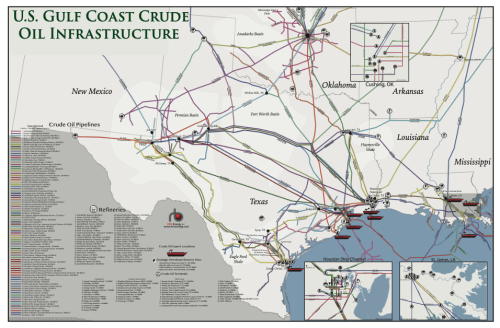
RBN’s US Gulf Coast Crude Oil Infrastructure Map - is up-to-date and provides a clear and comprehensive view into North America’s most dynamic and important crude oil market landscape.
All of this is helping to lock in Corpus Christi as one of the Gulf Coast’s leading export hubs. It supports 857 Mb/d of refining capacity — Valero (370 Mb/d), Flint Hills (320 Mb/d) and CITGO (167 Mb/d) — but Corpus’s key strength is its export capabilities. According to our Crude Voyager report, 2.25 MMb/d has been exported from Corpus Christi so far this year, with the majority of that coming from the Permian Basin. Enbridge Ingleside Energy Center (EIEC) and South Texas Gateway (STG) are the region’s top two crude export terminals by volume, and each can partially load Very Large Crude Carriers (VLCCs). EIEC has exported 1.09 MMb/d as of the end of November and STG has exported about 661 Mb/d in the same time period.
Four pipelines constructed over the last 10 years have been a major catalyst for getting rising Permian oil to Corpus Christi. Cactus I (light-green line in Figure 1 below) was an early mover. The original Cactus Pipeline, a 310-mile, 20-inch-diameter line from McCamey to Gardendale, began operations in 2015 to move Permian and Eagle Ford crude. Capacity grew from 250 Mb/d in 2015 to 390 Mb/d today via additional pumps and other upgrades. It is owned and operated by Plains All American.
About the song
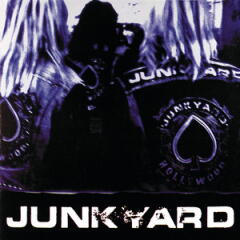
“Can’t Hold Back” was written by Chris Gates, David Roach, Patrick Muzingo and Clay Anthony. It appears as the third song on side two of Junkyard’s eponymous debut album. The hard-rocking song about a Hollywood rock-and-roll girl is powered by loud guitars and the strong vocals of David Roach. Personnel on the record were: David Roach (lead vocals, percussion), Chris Gates (guitar), Brian Baker (guitar), Clay Anthony (bass) and Patrick Muzingo (drums, percussion).
The album, Junkyard, was recorded at Conway, Studio Sound, and One On One in Los Angeles during 1988 and 1989. Produced by Tom Werman, the album was released in May 1989 and went to #105 on the Billboard 200 Albums chart. Two singles were released from the LP.
Junkyard is an American rock band formed in East Hollywood in 1987 by Austin, TX, punk-rock musicians Chris Gates (Big Boys), David Roach (Strappados, Pagans) and Max Gottlieb (Strappados), along with Los Angeles musicians Johnny Hell and Clay Anthony. The band made a name for themselves in the Los Angeles underground club scene with a sound combining Motorhead with Lynyrd Skynyrd, with a healthy dose of punk-rock attitude thrown in the mix. Geffen Records signed the band in 1988. Drummer Hell was replaced by Patrick Muzingo (Decry) and guitarist Gottlieb was replaced by Brian Baker (Minor Threat, Dag Nasty). They released two studio albums and seven singles for Geffen. They have released four studio albums, a live album, an EP, and a single on indie labels. Ten members have passed through the band since its formation. Clay Anthony died in Hawaii in December 2020. David Roach died in Omaha, NE, in August 2025. The future of the band is unknown at this time.
On a personal note, David Roach has been a good friend of your managing director of musicology at RBN since the late 1980s. Junkyard, Little Caesar and my band, Dirty Dogs, shared a rehearsal studio in Hollywood back then. For a brief time, there was a magical scene of real rock-and-roll street bands playing the underground club circuit in Los Angeles. Real camaraderie and friendships were forged, all the cool bands would be at our friends’ shows, supporting them and nurturing the scene. David Roach was a guy who was a major part of that scene. He sang on some of my demos, we did a country project together, and he was always this great guy to know. He would always light up a room with his great personality, wicked sense of humor and rock-and-roll attitude. He was a great singer and performer, a chef, a family man, and will be greatly missed. Rest in peace, David. Sincere condolences to his family, friends, and Junkyard fans.
"About the Song" -- written by Mickey McMahan , RBN Director of Musicology