


Mexico’s LNG sector has seen notable advancements in the past year, including new export project announcements and strategic investments. But many of the proposed LNG projects require extensive pipeline buildouts — no easy task south of the border and perhaps the biggest impediment most of the export projects face. In today’s RBN blog, we’ll look at where things stand with Mexico’s LNG sector and the export projects under development.

Join industry leaders in Calgary on October 29 for market insights, technical presentations, Duvernay inventory analysis, an expert panel, and networking focused on the next chapter of Canadian energy.
Mexico has an estimated 17 Tcf of proven natural gas reserves and gas is increasingly being used to replace oil as a feedstock in power generation. However, while Mexico has an estimated 545 Tcf of technically recoverable shale gas resources, the sixth-largest in the world, unlocking their full potential is hindered by the limited availability of the required technology, the accessibility of low-cost U.S. natural gas, proposals to ban fracking in shale gas extraction, and the hefty challenges that come with building a pipeline in Mexico (more on that in a bit). Despite those challenges, Mexico has encouraged domestic production by inviting private companies to bid on new gas pipelines and storage facilities for imported U.S. gas, and there are at least a half-dozen LNG export projects underway.
Before we get into the LNG export projects under development, we should note that New Fortress Energy (NFE) shipped the first cargo from its Altamira LNG export project (green diamond in Figure 1 below) on Mexico’s east coast in August 2024. The 1.4-million-tons-per-annum terminal (MMtpa; 0.2 Bcf/d), a floating LNG (FLNG) facility on three jack-up rigs that rest on the sea floor, has since exported two additional cargoes. A second FLNG unit at Altamira is expected online in H1 2026 and will increase the terminal’s capacity to 2.8 MMtpa (0.4 Bcf/d). The initial FLNG unit at Altamira was the first of its kind in Mexico. The shipments were delivered (via the Panama Canal) to NFE’s La Paz power plant in Baja California state, with future cargoes planned for global markets.
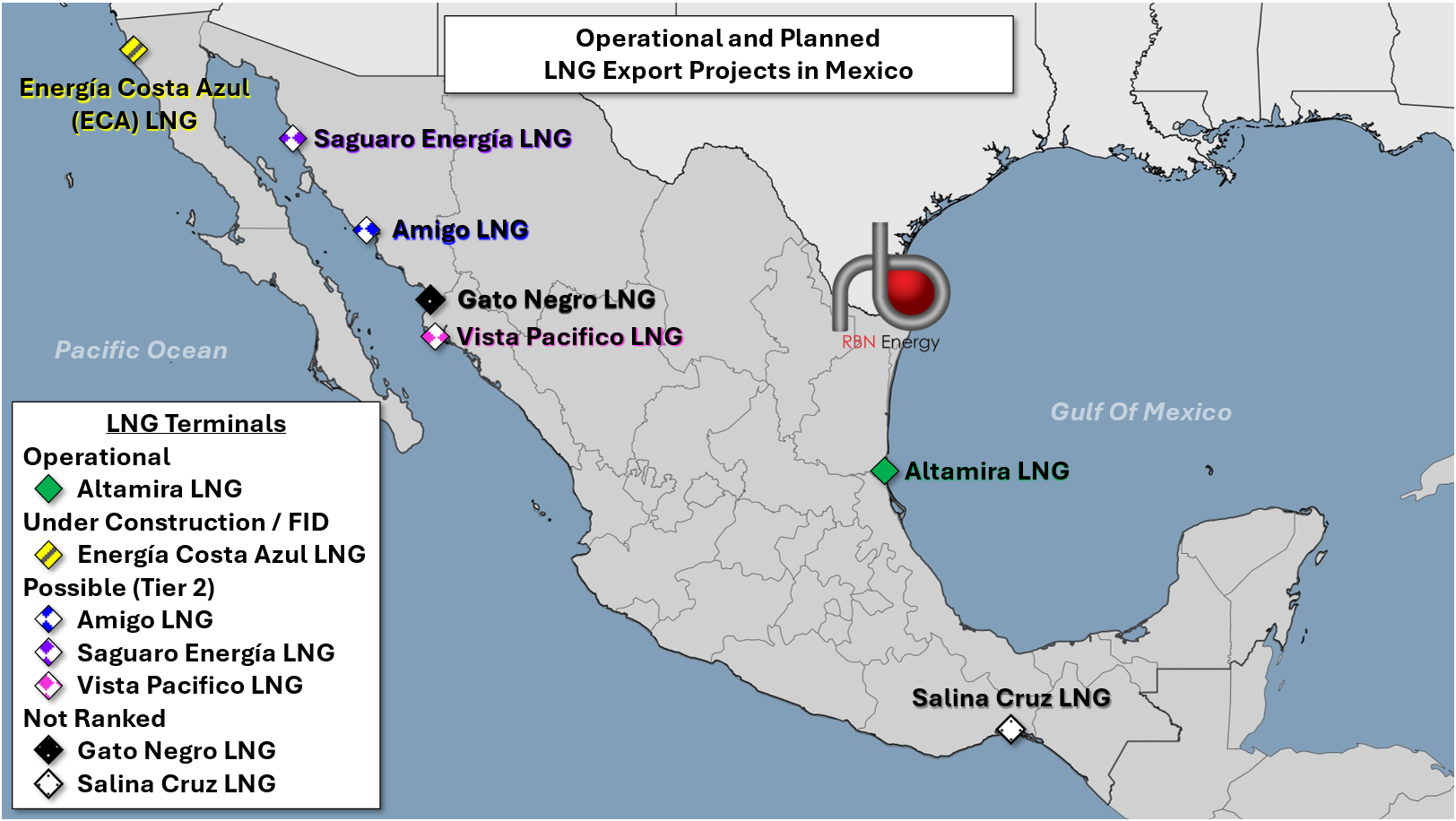
Figure 1. Operational and Planned LNG Export Projects in Mexico. Source: RBN

About the song
“The Waiting Game” was written by Buzz Cason. Cason was a member of Brenda Lee’s backing band when he wrote the song and pitched it to Lee’s producer, Owen Bradley. The song appeared as the B-side of Brenda Lee’s single, “Think.” Released in March 1964, “Think” went to #25 on the Billboard Hot 100 Singles chart. “Think” would later appear as the sixth song on side two of Lee’s 13th studio album, Too Many Rivers, released in September 1965.
Brenda Lee is an American singer and chart-topping female vocalist of the 1950s and ’60s. Her career started in 1956 at the age of 12. After her second hit single, “Dynamite,” the diminutive 4-foot, 9-inch singer became known as “Little Miss Dynamite.” She has released 29 studio albums, 26 compilation albums and 72 singles, three of which were #1 hits. She is a member of the Rock and Roll Hall of Fame, the Country Music Hall of Fame and the Rockabilly Hall of Fame. Lee also has a Grammy Lifetime Achievement Award. At the age of 80, Brenda Lee is retired and lives with her husband in Nashville.







Comments
NFE's Altamira facility is on a jackup rig that rests on the sea floor. Not that this changes much, it's just that I read all the time in the trade press that Altamira is a floating LNG plant when it's actually not.
Also note that MPL has signed SPAs with Woodside & POSCO, in addition to the other buyers mentioned in the article.