For decades, liquidity at the U.S. natural gas benchmark pricing location Henry Hub in Louisiana has been dominated by financial trades, with minimal physical exchange of gas, despite the hub boasting robust physical infrastructure, including ample pipeline connectivity. But that’s changing. Between the start of LNG exports from Cheniere Energy’s Sabine Pass LNG facility in February 2016, and the slew of pipeline reversals that are allowing Marcellus/Utica producers to target the new Gulf Coast demand, gas flows through Henry have been rising. In fact, more physical gas is moving through the hub than in nearly 10 years, to the point where a key pipeline interconnect is at capacity on many days, which historically was unheard of. Today, we begin a short series looking at the changing physical market at Henry.
We first delved into Henry Hub in our series Henry the Hub, I Am I Am, including its formation as a trading location and the rationale behind its status as both a spot market and futures contract delivery point. In that same series, we also alluded to the potential for gas flows and market dynamics at Henry Hub to shift with the emergence of a new demand source right in its backyard — namely LNG exports — and the push among Marcellus/Utica producers to target that demand. Now, two years after the first export cargo left Cheniere’s Sabine Pass LNG facility in Cameron Parish, LA, we are starting to see the effects of that export demand and supply influx on Henry Hub, including increased flows and even constraints. In this series, we’ll dive into those flow dynamics. But first, it’s worth putting it into context by reviewing the salient features and historical role of the hub.
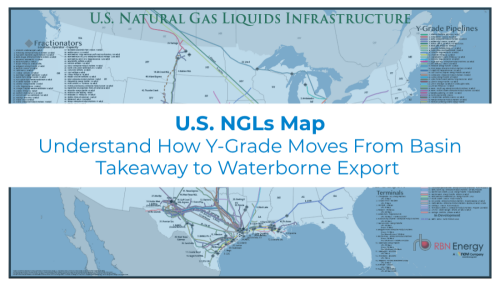
Visualize the infrastructure behind U.S. NGL movement.
The U.S. NGLs Map provides a comprehensive view of the transport, processing, and export networks moving NGLs across the U.S.
It’s no exaggeration to say that the Henry Hub pricing location, which is situated in Vermillion Parish, LA, is the center of the natural gas spot-trading universe. It also serves as the delivery mechanism for the third-largest commodity futures trading instrument in the world — the CME/NYMEX Henry Hub natural gas futures contract. So, it’s safe to say, Henry Hub in some way touches almost every aspect of the U.S. natural gas market.
What makes Henry Hub an attractive benchmark is the bevy of major long-haul, large-diameter, high-capacity pipelines that converge in the vicinity, resulting in high deliverability at the hub. The backbone of Henry Hub is Enlink Midstream’s Sabine Pipeline, a 130-mile, ~500-MMcf/d east-west mainline extending from Erath, LA, to the industrial complex at Port Arthur, TX.

About the song
"Roll With Me Henry" was written by Etta James, Johnny Otis, and Hank Ballard, and recorded in late 1954 for Modern Records in Los Angeles by Etta James (who was sixteen at the time). When released as a single, it rose to the top of the R&B charts for four weeks in February 1955. The record was produced by Johnny Otis, who is also responsible for Jamesetta Hawkins changing her name to the simpler Etta James.
The male vocal responses on "Roll With Me Henry" are done by Richard Berry, the man who wrote and recorded the original version of "Louie, Louie."
The title of “Roll With Me Henry” was changed to "The Wallflower," because D.J.’s were afraid the original title would be too risqué to say on the air (although it is sung throughout the song). The song was recorded as a response to an earlier hit penned by Hank Ballard, "Work With Me Annie," made popular by his group The Midnighters. Ballard later responded with two "answer to the answer" songs: "Henry's Got Flat Feet (Can't Dance No More)" and "Annie Had A Baby & Can't Work No More," also recorded by The Midnighters.
In late 1955, “Roll With Me Henry” was reworked with tidied-up lyrics and a new title — "Dance With Me Henry" — and released by pop singer Georgia Gibbs. That version rose to #1 on the Billboard Hot 100. Etta's original version of would later appear in the films, Sister Act and Back To The Future.
Etta James's long career in rhythm & blues and rock & roll would continue until her passing in 2012. She has won six Grammy Awards, seventeen Blues Hall of Fame Awards, a BMI Lifetime Achievement Award, and a star on the Hollywood Walk of Fame. She was inducted into the Rock and Roll Hall of Fame in 1993, the Grammy Hall of Fame in 1999, and the Blues Hall of Fame in 2001. Many artists have covered her vast catalog of songs over the years.