


This month the North Dakota Industrial Commission (NDIC) indicated they are leaning towards leniency in their treatment of operators that have drilled but not completed wells within the one-year time frame permitted. Instead of assuming such wells are abandoned, which would otherwise mean an expired drilling permit and about $200,000 in plugging costs, – the State plans to give operators more time. That possibility opens up a whole new underground storage option for producers struggling to make ends meet. Today we explain the NDIC plan.
There has been a significant increase in State tax revenues from the oil and gas sector over the past 4 years as drilling and production from the prolific Williston Basin boomed in North Dakota. Little wonder that the State’s NDIC has done its best to keep producers actively engaged in drilling even as crude prices have fallen during the past year. To that end as we detailed back in April (2015) the State legislature has provided tax incentives to producers drilling during periods of time when prices fall below certain thresholds (see I Cannot Compete With Your Tax Scheme). There were two such tax breaks on the table this year – with the so called “small trigger” incentive providing a 4.5% break on the State’s 6.5% Extraction Tax (applied to the gross value of oil produced at the well) between February and June 2015 for all new horizontal wells when average oil prices dropped below $57.50/Bbl in January 2015. The second, “large trigger” tax break would have waived the Extraction Tax altogether for 24 months for all producers provided prices stayed below a $55/Bbl threshold for 5 consecutive months. When we last wrote on those tax breaks producers were confidently expecting to enjoy a waiver of extraction taxes after June 2015 on the assumption that the 5 month low price criteria was met. Unfortunately for them - as shown in Figure #1 below - the trigger was never pulled because average prices for the West Texas Intermediate (WTI) benchmark crude target (red line) were higher than the threshold in May and then again in June (orange dashed circle). As a result the Large Trigger was not enacted and producers did not enjoy the tax break.
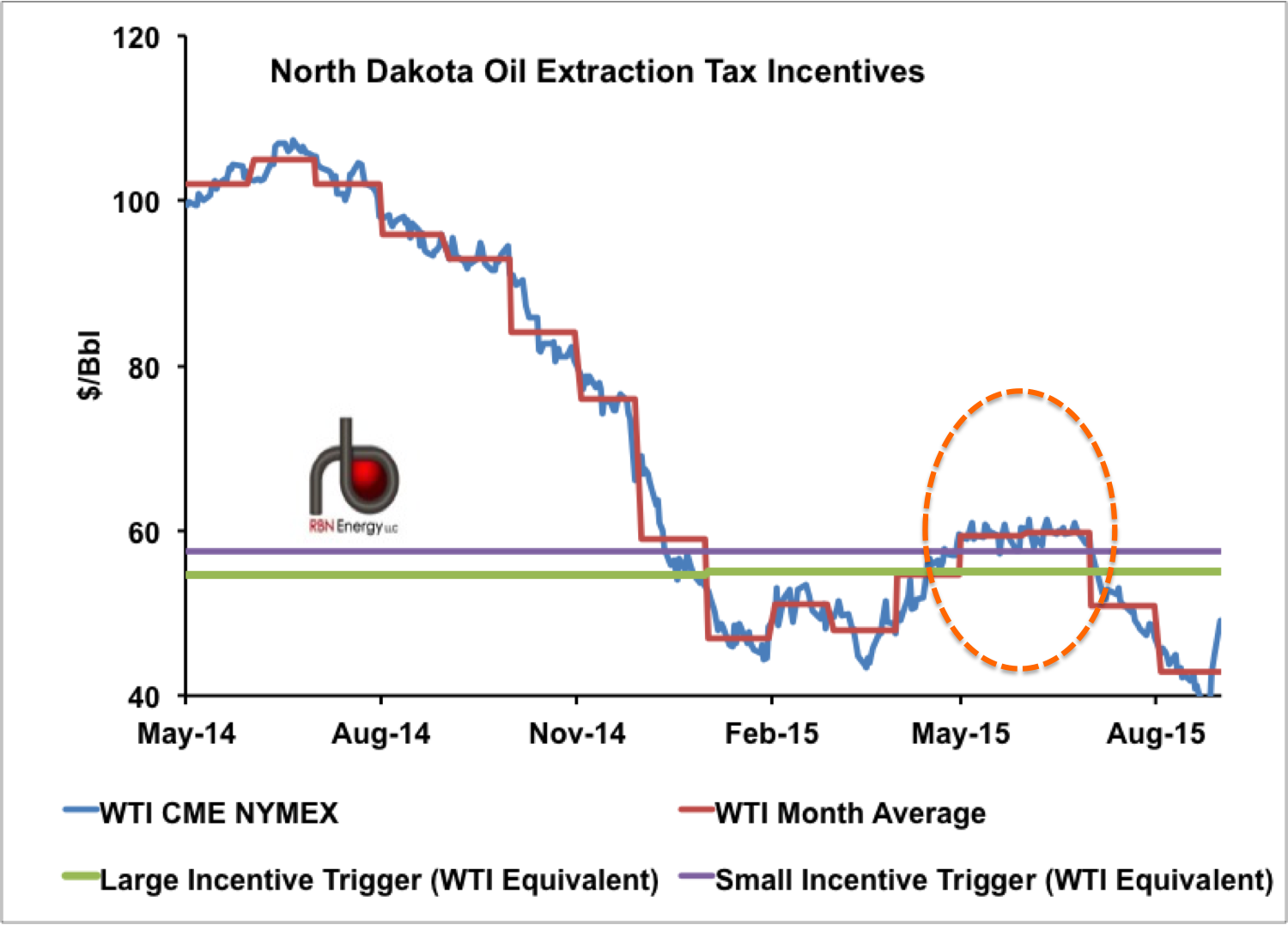
Figure #1, Source: NDIC, CME Data from Morningstar
Since June (2015) the NDIC has indicated concern during their monthly press conferences with the increasing number of North Dakota wells that have been drilled and are yet to be completed. (Completion means when the first oil is produced through wellhead equipment into tanks.) North Dakota drilling permits expire one year after they are issued – meaning that producers lose their permit if they do not drill and complete a well within a year after obtaining the permit. Such provisions are common in the industry and similar provisions are also often included in the operator’s Mineral Rights Lease with the Royalty Owner (see Held On Tight By Production). Obviously both the Royalty Owner and the tax authority are incentivized to get production underway as quickly as possible to get revenues.

About the song
"Incomplete" by the Backstreet Boys was a hit single from their comeback album, Never Gone released in 2005, written by Dan Muckala, Lindy Robbins, and Jess Cates. The song became one of their most successful singles, peaking at number thirteen on the US Billboard Hot 100, and charting within the top 10 of fourteen countries. It debuted at number one in Australia.






Comments
Thank you for another terrific article. I am a little puzzled regarding North Dakota's backlog. If we take the increase in total Bakken producing wells from December 31, 2014 to the end of July, we have an increase in producing wells of 1,091 wells placed on production (net of any wells that may have been plugged or abandoned). The data can be found here from the DMR https://www.dmr.nd.gov/oilgas/stats/historicalbakkenoilstats.pdf
If we compare this to the number of wells Spud from January 1, 2015 to July 31, 2015 also from the DMR we have a total of 858. https://www.dmr.nd.gov/oilgas/stats/2015monthlystats.pdf
So according to ND DMR, wells placed on line exceeded the number of wells started by at least 233 or a fairly significant 27% more wells. This must mean that the backlog has been reduced significantly through July, not increased. Maybe some of the discrepancy is due to classification between the wells drilled and not yet completed and the wells completed but not yet producing. Regardless, it means that the backlog of drilled wells completed or not has been significantly reduced.
I tend to believe the discrepncy relates more to how the agency estimates the number of wells waiting on completion. This is there disclaimer on how wells waiting on completion is derived.
"2 Disclaimer: The number of wells waiting on completions is an estimate on the part of the director based on idle well count and a typical five year average. Neither the State of North Dakota, nor any agency officer, or employee of the State of North Dakota warrants the accuracy or reliability of this product and shall not be held responsible for any losses caused by this product. Portions of the information may be incorrect or out of date. Any person or entity that relies on any information obtained from this product does so at his or her own risk. "
In summary it appears that the ND DMR's data provides evidence that the ND Bakken backlog has been substantially reduced which does not fit their narrative.
It is a big deal because instead of efficiencies driving steady production with an increasing backlog, it points to the opposite. That production has been maintained (actually decreased 2%) with a substantial number of wells completed from their backlog. Which likely means that the current level of activity is woefully inadequate to maintain production contrary to what is being presented.
I wrote to the DMR about this discrepancy and recieved this reply. The following reply points to the number of completions likely to be less accurate than the other data I referenced.
"Hi Doug-
Thank you for your email.
We are always looking for better ways to refine and track our data- however some of the data within the Director’s Cut (completions) are estimates and may not always be 100% accurate- that is the reason we provide the disclaimer within the report.
Thanks,"