The Federal Energy Regulatory Commission (FERC) issued two new statements of policy February 17 regarding the certification of new pipelines and the assessment of greenhouse gas (GHG) impacts. Together, the two updates reflect a more meticulous regulatory environment and a stricter adherence to policies that midstreamers must comply with in an effort to avoid lengthy and expensive court challenges that have become more commonplace recently. The guidelines will affect most new projects within FERC jurisdiction and, among those, some of the biggest impacts will be felt in the U.S.’s rapidly expanding LNG sector — the terminals themselves and the pipelines that deliver feedgas to them. That could be cause for concern as Russia’s war on Ukraine has exacerbated an already precarious gas situation in Europe and a global LNG supply crunch. In today’s RBN blog, we explain the impact of FERC’s latest guidance on pipeline certification and GHG policy with regard to the LNG sector.
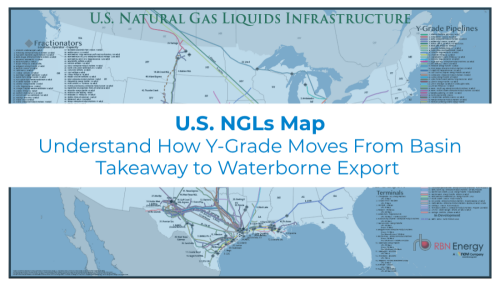
Visualize the infrastructure behind U.S. NGL movement.
The U.S. NGLs Map provides a comprehensive view of the transport, processing, and export networks moving NGLs across the U.S.
In Part 1, we looked at the clarifications provided by FERC regarding the Updated Certificate Policy Statement (PL18-1) and Interim GHG Policy Statement (PL 21-3). We concluded that, overall, the Certificate Statement of Policy (SOP), which outlines the criteria that new FERC-regulated projects must meet for certification, would put a renewed emphasis on factors other than precedent agreements such as community impact, but really it just echoes what the FERC is already doing. So, while the Certificate SOP represents a recommitment to more stringent standards that new projects must meet, prudent project sponsors would have anticipated and planned for those hurdles. In other words, it shouldn’t be a big step change from the criteria already being applied. In contrast to the Certificate SOP, which has already been in effect for decades, the GHG SOP will eventually lead to a final policy statement after the commission receives comments. Depending on the language included in the GHG policy once finalized, it is likely to require an Environmental Impact Statement (EIS) for projects with a relatively low emissions threshold of 100,000 metric tons per year (MT/year). The preparation and approval of an EIS is much more time-intensive than the Environmental Assessment (EA) and could eventually end up being a bigger burden to new projects, especially if the final version of the guidance includes a requirement to assess the downstream impacts of Scope 3 emissions — those related to the ultimate consumption of natural gas and other hydrocarbons.
As the guidance exists now for the two SOPs, the impact to most gas projects should be fairly minor, but that is true only because the environment at FERC and the U.S. Court of Appeals for the DC Circuit was already much tougher after a changing of the guard inside those organizations in the last couple of years. However, those tougher standards are already significantly lengthening the time it takes to move through the FERC approval process, adding even more uncertainty to midstream development. That’s a tough pill to swallow for the developers of smaller projects that may not have the economies of scale to address such rigorous standards. From a macro, long-term view, though, the biggest potential impact from the Certificate and GHG SOPs combined may be to the huge LNG export facilities aiming to send U.S. gas into the international market and the pipelines that feed the terminals. Importantly, the SOPs will impact some projects more than others.

About the song
“Climb That Hill” was written by Tom Petty and Mike Campbell and originally appeared as the fourth song on the ninth studio album of Tom Petty and the Heartbreakers: the soundtrack album for the movie She's the One. Released as a single in August 1996, the song went to #6 on the Billboard Mainstream Rock Tracks Singles chart. The song was included on the 2020 release of Wildflowers and All the Rest. Personnel on the record were: Tom Petty (vocals, guitars, harmonica, piano, harpsichord), Mike Campbell (guitars, piano), Benmont Tench (organ, piano), Howie Epstein (bass, backing vocals), and Curt Bisquera (drums).
She's the One was recorded between 1992 and 1996 at Sound City, Village Recorders, and Andora Studios in Los Angeles. Some of the songs included on the album were extras from the Wildflowers sessions when it was decided to make Wildflowers a single album instead of a double LP. She's the One is the soundtrack LP for the 1996 Edward Burns film of the same name. Produced by Rick Rubin, Tom Petty, and Mike Campbell, the LP was released in August 1996. It went to #15 on the Billboard 200 Albums chart and has been certified Gold by the Recording Industry Association of America. Three singles were released from the LP. A re-worked version of the album was released under the title Angel Dream for Record Store Day in 2021.
Tom Petty was an American singer, songwriter, musician, and record producer. He released 16 studio albums, eight live albums, five compilation albums, and 68 singles as a member of Tom Petty and the Heartbreakers. He released three studio albums as a solo artist, two albums and five singles with the Traveling Wilburys, and two studio and one live album with Mudcrutch. Petty has sold more than 80 million records worldwide. He also has received a Gershwin Award for Lifetime Musical Achievement and is a member of the Rock and Roll Hall of Fame. Petty died in October 2017.