Natural gas prices at the Waha Hub in West Texas averaged below zero every month between September 2025 and May 2026, except January, then shot back above zero in mid-June as the Gulf Coast Express expansion began service. With Hugh Brinson now online as well and even more capacity coming in the years ahead, the basin has likely seen the last of negative prices for years to come. But how can we be sure the region has sufficient takeaway capacity? Or more importantly, how can we identify where or when the next potential bottleneck might be? In today’s RBN blog, we’ll highlight the importance of gas-flow analysis and pipeline modeling. Today’s blog also serves as an unabashed preview of our upcoming Natural Gas Master Class, an online-only event to be held Wednesday, October 21.
Given the rapid buildout of natural gas pipelines in recent years, with more on the way, understanding gas flows has never been more crucial. The ability to read pipeline data, model regional production and forecast market shifts is what separates accurate analysis from guesswork. As more and more gas flows toward the Gulf Coast to serve LNG export demand, understanding shifting flow dynamics and localized market constraints has become increasingly important to understanding the big picture of U.S. energy markets as well as global gas markets. An incredible amount of data is available, unlocking real-time market information, but you have to know how to read and interpret it.

As we wrote in Open The Door, Permian gas production had been constrained until recently, causing negative cash prices in the basin for some time before the Gulf Coast Express expansion began service. The basin produces massive amounts of associated natural gas, but because of its location in West Texas and southeastern New Mexico there is almost no local market to serve. Nearly all the production in the basin is consumed elsewhere, and that requires massive pipeline takeaway capacity.
The U.S. has two different types of pipelines, interstate (those that cross state lines) and intrastate (those that don’t). Nearly all of the buildout already online and still coming in the Permian is comprised of intrastate pipelines, which are not regulated by the Federal Regulatory Energy Commission (FERC). Intrastate pipelines have to report far less data than the pipelines that cross state lines and don’t report any flow data, and often companies don’t even announce that a project has come online until well after the fact. So, given the lower reporting requirements, how do we even know that the Gulf Coast Express expansion or Hugh Brinson are online?
We can see it in the market, in the price response and pipeline flow response of connected infrastructure. Let’s start with Gulf Coast Express, which took the market from constrained to unconstrained and is obvious to see — if you know what to look for. First, from a pricing perspective, in just a few days this summer, Waha cash prices (blue line in Figure 1 below) went from less than negative $1/MMBtu to above $1.50/MMBtu. Prices averaged just above zero (horizontal red line) in June and have been largely between $1.50/MMBtu and $2/MMBtu since July.
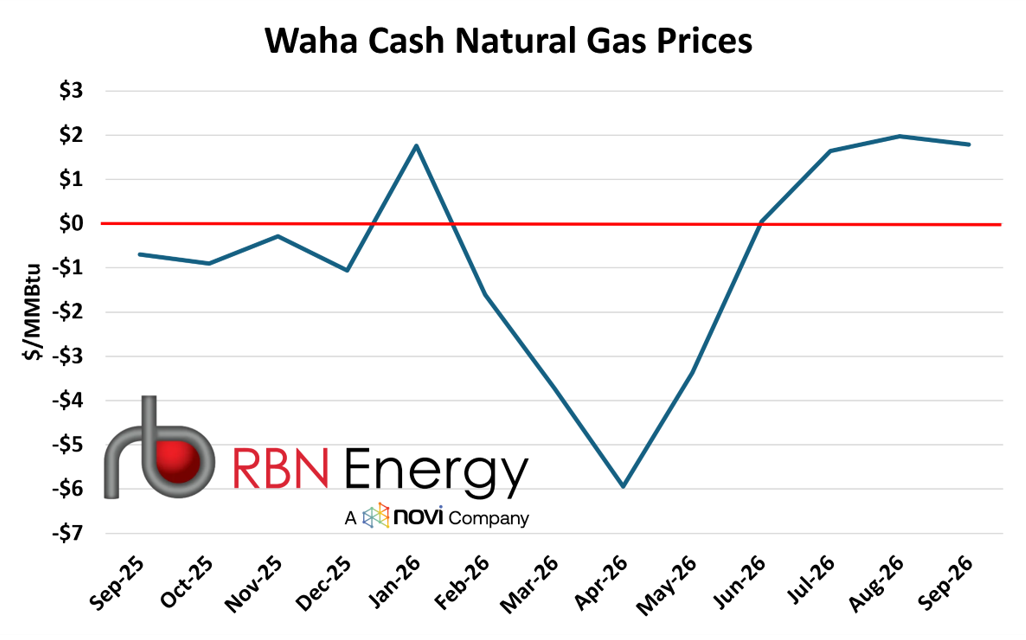
Figure 1. Waha Cash Natural Gas Prices. Source: Natural Gas Intelligence

About the song
Aimee Mann originally wrote “Wise Up” for a scene in the 1996 Cameron Crowe romantic comedy Jerry Maguire. Crowe wanted to use the song in a particular scene but felt Mann’s final version was “larger, more lush, and too big for the scene it was meant for.” Crowe said it was heartbreaking that it was not used in the film, but it was included as the 10th song on the Jerry Maguire: Music From the Motion Picture soundtrack album, released in December 1996. It went to #49 on the Billboard 200 Albums chart. The ballad was about wising up to the fact that only you are going to be responsible for making changes to destructive patterns and emotional crises.
The song later appeared as the eighth track on the soundtrack album Magnolia: Music From the Motion Picture, released along with the film of the same name in December 1999. Mann wrote and performed nine songs on the LP. “Wise Up” was never released as a single. Personnel on the record were: Aimee Mann (lead vocals, bass, guitar), Benmont Tench (piano), Jon Brion (Chamberlin), Michael Penn (backing vocals) and Dan MacCarroll (percussion). Magnolia: Music From the Motion Picture is the soundtrack for the 1999 film of the same name. It features songs by Aimee Mann, plus tracks from Gabrielle, Supertramp and Jon Brion. Released in December 1999, it went to #58 on the Billboard 200 Albums chart and has been certified Gold by the Recording Industry Association of America. One single was released from the LP.
Aimee Mann is an American singer-songwriter and musician. She was a student at Berklee College of Music before founding the band ’Til Tuesday. She co-wrote their Top 10 hit, “Voices Carry.” After three albums with ’Til Tuesday, Mann left in 1990 to pursue a solo career. She has released 10 studio albums, a live album, a soundtrack album, a compilation album, and 30 singles. She has won two Grammy Awards and an MTV Video Music Award. She continues to write music. Her last album was Queens of the Summer Hotel, released in November 2021. She last appeared onstage in June, singing “Time Stand Still” with Rush at the opening night of their Fifty Something Tour in Los Angeles.
"About the Song" -- written by Mickey McMahan , RBN Director of Musicology