



The latest Energy Information Administration (EIA) April 2013 short term energy outlook forecasts US crude oil production to increase from an average of 6.5 MMb/d in 2012 to 7.9 MMb/d in 2014. Surging crude production needs to find routes to market – and often competes for pipeline space with growing Canadian imports. New crude pipelines are taking too long to build. At the same time many natural gas pipelines are flowing far beneath capacity because new gas production nearer to market makes them redundant. Converting these natural gas pipelines to crude oil use where geography allows is a potential win-win. Today we look at gas to crude pipeline conversion economics.
In the past three years there have been numerous projects floated to convert natural gas pipelines to oil. Here are four of the latest examples:
Pony Express Pipeline (PXP)
To be completed in 3Q 2014 the PXP involves the conversion of a natural gas pipeline running from Guernsey, WY to Ponca City, OK to crude oil in order to expand takeaway capacity from the Rockies. The project will convert 430 miles of natural gas pipeline from Lincoln KS to Guernsey and then build a new pipeline extension from Lincoln to Ponca City and Cushing. Originally a Kinder Morgan project the pipeline is now owned by Tallgrass Energy Partners.
Trunkline (Energy Transfer Partners)
The Federal Energy Regulatory Commission (FERC) approval process for conversion of one of two lines in a 770 mile segment of the Trunkline Gas pipeline to oil service passed the environmental impact test this week. A 50/50 joint venture between Enbridge and Energy Transfer Partners will convert the 30 inch pipeline from carrying natural gas to 420-660 Mb/d of crude oil between Patoka, IL and St. James, LA. Pending completion of FERC approvals the pipeline would enter service in July 2015.
Kinder Morgan Freedom Pipeline Project
Kinder Morgan this week announced that it is conducting an open season to gauge interest in the conversion of one of two lines in a 740 mile segment of its existing El Paso Natural Gas pipeline to crude oil service. The “Freedom Pipeline” would transport 277 Mb/d of crude oil from the Permian Basin of west Texas to refineries in California (see map below).
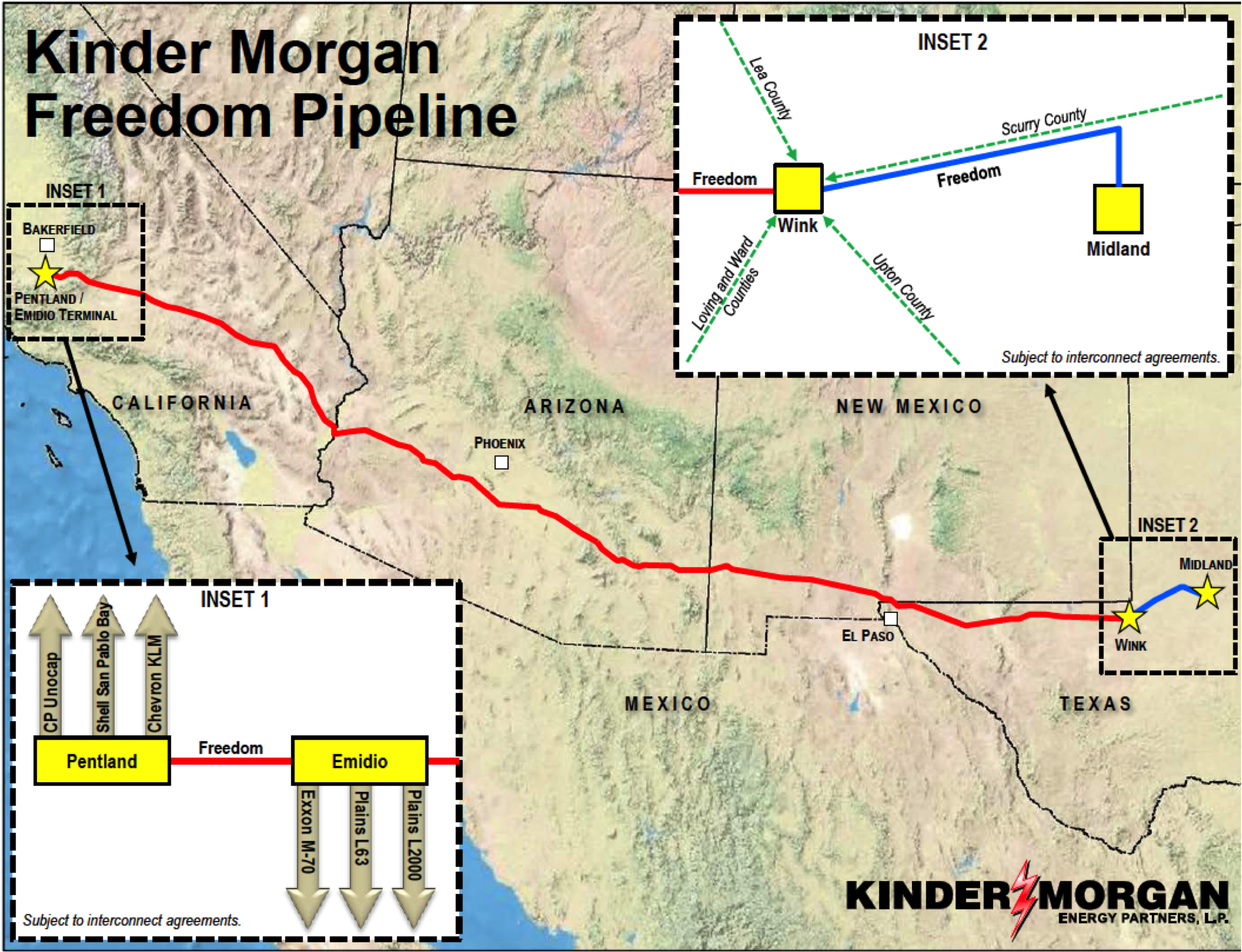
Source: Kinder Morgan Open Season Announcement
TransCanada Energy East Project
TransCanada is holding a an open season from April 15 to June 17, 2013 to obtain firm long-term commitments from interested parties in their Energy East Pipeline Project. The 2700 mile 500-850 Mb/d crude oil pipeline would run from Hardisty, AB to St. John, New Brunswick. The pipeline would transport crude from Western Canada to Eastern Canadian refineries and potentially provide a path for the export of Western Canadian crude to Atlantic Coast markets and Europe (see West Coast Pipe Dreams). The Energy East pipeline is expected to be in service between the end of 2017 and early 2018 pending permits and approvals. The project involves conversion of capacity on the existing TransCanada Mainline gas pipeline that has recently suffered reduced flows as a result of competition from increased US shale gas production in the Northeast (see Gulf Coast Gas We Don’t Need Ya Anymore and Return To Sender).

About the song
“One Way or Another” was written by Debbie Harry and Nigel Harrison and appears as the second song on side one of Blondie’s third studio album, Parallel Lines. Harry wrote the lyrics about an ex-boyfriend who was hassling her about their breakup in the early 1970s. Released as a single in May 1979, it went to #24 on the Billboard Hot 100 Singles chart. Personnel on the record were: Debbie Harry (vocals), Jimmy Destri (keyboards), Frank Infante (guitar), Chris Stein (guitar), Nigel Harrison (bass), and Clem Burke (drums). The boy band One Direction covered the song combined with the Undertones’ “Teenage Kicks” in 2013. Released as a charity single, their version went to #13 on the Hot 100 Singles chart and was certified Gold by the Recording Industry Association of America (RIAA).
Parallel Lines was recorded in June and July 1978 at the Record Plant in New York City with Mike Chapman producing. Chapman initially found the band unprofessional and difficult to work with, claiming there was a lot of animosity in the studio. However, after the success of Parallel Lines, the band and Chapman continued to work together and produced three more successful albums. The album was released in September 1978 and went to #6 on the Billboard 200 Albums chart and was certified Platinum by the RIAA. According to rock critic Robert Christgau, it was a pop rock album in which Blondie achieved “a synthesis of The Dixie Cups and The Electric Prunes.” Six charting singles were released from the LP.
Blondie is an American rock band formed in New York City in 1974 by Chris Stein and Debbie Harry. The two met in 1973 while playing together in the New York band The Stilettos. After leaving that band, they formed Blondie with drummer Clem Burke and bassist Gary Valentine. Blondie was a regular at CBGB and Max’s Kansas City before signing a record deal with Private Stock Records in 1975. They released two punk-oriented albums for that label before making changes to the band and signing with Chrysalis Records in 1977. After major mainstream success, the band broke up in November 1982, with members going different ways to various projects. Blondie reformed in 1997 and toured and recorded with original members Stein, Harry and Burke always on board. The band has released 11 studio albums, four live albums, 14 compilation albums, three EPs and 38 singles and has sold more than 40 million records worldwide.
Blondie was inducted into the Rock and Roll Hall of Fame in 2006. The band still records and tours, and last appeared at the 22nd Coachella Valley Music and Arts Festival in April 2023. They are scheduled to appear this month at the Annapolis Songwriter Festival in Maryland and the Bourbon & Beyond Festival in Louisville.







Comments
One of the issues will be having to re-engineer the hydro on the line as it was built from CA to Wink. The hydraulics on it have the thin wall of the pipe on the wrong side of the mountains. This is not that important for NatGas but chingles for liquid. This can be overcome, but the pressure for liquids will make this one interesting project. Maybe get a chance to finish up my career on this one. But then you have to deal with what the refinerys in CA are capable of running. The new crudes coming from the PB are light sweet where the refinerys in CA are set up for the heavy, sour asphalt based from CA and ANS which is a heavy grade. Maybe they will get Canadian to CA, but again the wall thickness of the pipeline is on the wrong side of the mountians if you are pushing from Wink.