


There’s never a dull moment in the ethane market. Four new steam crackers and an expansion at an existing plant are slated to begin operating along the Gulf Coast in 2019, and a recently restarted Louisiana cracker will continue to ramp up to full capacity — together adding about 250 Mb/d of ethane demand by year’s end. You’d think there would be plenty of ethane out there for them. After all, U.S. NGL production has been on the rise, driven in part by new Permian gas processing plants and new NGL pipeline capacity to the coast. But fractionation constraints at the Mont Belvieu hub are likely to linger through 2019, raising questions about how much ethane will actually be produced and how much will need to be rejected into pipeline gas. Today, we consider the challenges facing the ethane market this year as demand increases and fracs run flat out to keep pace.
The Shale Revolution has had many effects on the U.S. economy, one of the most significant being the revival of the domestic petrochemical industry. When it became clear a few years ago that production of natural gas liquids (NGLs) would be taking off — and high production volumes could be sustained for decades — a number of petchem companies committed to building new ethylene plants (a.k.a. steam crackers), most of them along the Gulf Coast and focused on cracking the lightest and most abundant NGL purity product of them all: ethane. As we’ve noted in almost every blog about ethane, it’s the chameleon of the NGL world — only ethane can either be rejected into natural gas for its Btu value or fractionated into pure ethane for cracking at ethylene plants. As we’ve also said, ethane’s unique versatility contributes to its volatility — both in terms of production volume and pricing — which makes it particularly challenging (and, for us, fun) to track.
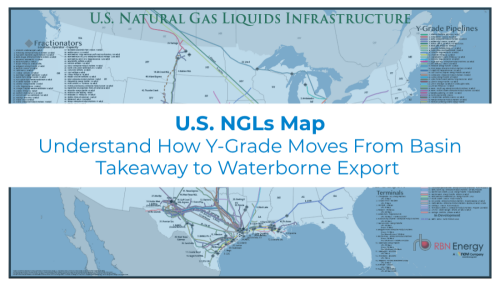
Visualize the infrastructure behind U.S. NGL movement.
The U.S. NGLs Map provides a comprehensive view of the transport, processing, and export networks moving NGLs across the U.S.
About a year and a half ago, in our Ethane Asylum Revisited blog series, we said that while 2015 through mid-2017 had been a wild period for the U.S. ethane market, things were about to get really crazy. A slew of new, ethane-only crackers were going to start coming online in Texas and Louisiana and — at the same time — exports of ethane (by pipe and by ship) were going to ramp up. In other words, a lot of incremental ethane demand was about to be added within a relatively short period of time, putting still more pressure on what would soon be a very stressed fractionation sector.

About the song
"Keep On Keepin' On" was written by Curtis Mayfield, and appears as the second song on Mayfield's second solo studio album, Roots. The LP was recorded at RCA Studios in Chicago, and released in October 1971. Mayfield wrote all the songs on the album and produced it. Roots went to #6 on the Billboard Top R&B Albums chart, and #40 on the Billboard Top 200 Albums list. Personnel on the record were: Curtis Mayfield (vocals and guitar), Craig McMullen (guitar), Joseph (“Lucky”) Scott ( bass), Tyrone McCullen (drums), and Henry Gibson (percussion).
Curtis Mayfield was an American singer-songwriter, guitarist, and record producer. He was one of the first musicians to bring the themes of social awareness into soul music. He first achieved success with The Impressions during the civil rights movement of the 1960s, and later did very well as a solo artist. He made 13 studio albums with The Impressions, and 19 studio albums on his own. Mayfield was inducted into the Rock and Roll Hall of Fame twice, once as a member of The Impressions, and once as a solo artist. He is also a two-time Grammy Hall of Fame inductee, and was awarded a Grammy Legend Award and a Grammy Lifetime Achievement Award. Mayfield passed away due to diabetes complications on December 26, 1999, at the age of 57.






Comments
Is today's blog part on ethane and fractionation constraints part of a series? I would have expected that RBN would have looked at potential supply from the Marcellus/Utica in light of recent RBN blogs about (a) delays in Mariner East, (b) the projection by East Daley that drilling in Appalachia is likely to become more liquids focused and (c) the ability to transport volumes fractionated in Appalachia to MB via ATEX.
In reply to Ethane Supply by Ian MacLean
ATEX is already running full