Back on March 15, the Federal Energy Regulatory Commission shook up master limited partnerships (MLPs) and their investors by deciding that income taxes would no longer be factored into the cost-of-service-based tariff rates of MLP-owned pipelines. We said then that there was no need to panic. In part, this was based on the view the FERC policy wouldn’t affect as much of the industry as some worried it would. But more importantly, our soothing message was tied to the fact it would take a long time for this to play out. It looks like we were right to have some confidence. Today, we explain why the commission’s July 18 vote on a topic as nerdy as “accumulated deferred income taxes” can warm the hearts of MLP investors.
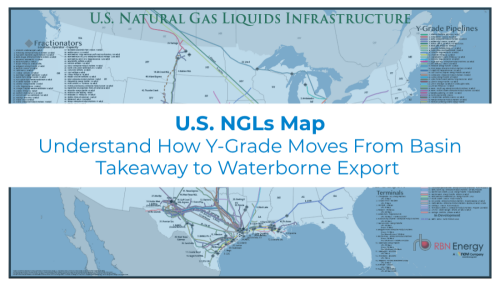
Visualize the infrastructure behind U.S. NGL movement.
The U.S. NGLs Map provides a comprehensive view of the transport, processing, and export networks moving NGLs across the U.S.
Twice in the past four months — in Part 1 and Part 2 of our “Freak Out!” blog series — we ventured into the strange and sometimes frightening world of FERC rate-setting, dealing with a decision that sent shock waves through the industry. In its March 15 decision, FERC told natural gas and liquids pipelines owned by master limited partnerships (MLPs) that they could no longer have an allowance for income taxes in the rates they would be allowed to charge shippers. The rationale was that MLPs didn’t pay income taxes at the partnership level — only their partnership-unit owners did, in the same way that stockholders in a corporation pay taxes on dividends (which also aren’t allowed in rates). Regardless of the reasoning, the impact had the potential to kick out as much as 10% or 15% of the total rate levels of the MLP-owned pipelines that use “cost of service” to set their rates. That made unit prices (the MLP version of a stock price) go down a lot and there was a hint of panic in the air. It calmed pretty quickly as we and others explained why the policy didn’t necessarily affect everyone, why it would take a while, etc.
Then in May, by which time not much had happened, we wrote Freak Out, Part 2 to explain the intricacies of the three things FERC had said March 15, how they related to each other and what they did, and we explained the concept of “FERC Time” — a pace considerably more stately than what we’re used to in a market-driven world. A few days ago (on July 18), FERC (its commissioners pictured below) took a couple of actions that make the situation a lot better for the industry, a rare piece of really good news for pipeline owners. It got everyone’s attention and made unit prices for a bunch of MLPs jump, some by double-digit percentages.

About the song
"Better Than I Thought It'd Be" is the sixth cut on country music singer Trace Adkins’s 10th studio album, X. The song was written by Jay Knowles and Kendell Marvel. X, released in November 2008, was recorded in Nashville, and produced by Frank Rogers; the LP –– which included two Top 20 singles –– reached #32 on the Billboard Top 200 Albums chart, and #7 on the Billboard Top Country Albums chart. The record features Trace Adkins on lead vocals, and over 27 studio musicians, with the additional support of the West Point Cadet Glee Club on the song "'Til the Last Shot's Fired."
Trace Adkins released his first album in 1996, and has gone on to sell over 10 million LPs, and has had three #1 country hits, and more than 20 singles on the Billboard Country Music charts. He won the Academy of Country Music’s (ACM) Top New Male Vocalist award in 1996, its Single of the Year award in 2008, and its Vocal Event of the Year award in 2009. Adkins is currently on his "How Did We Get Here" tour.