The saying goes, “If you got it, flaunt it,” and the rise of social media has certainly accelerated the ostentatious display of sudden wealth by rock stars, rappers, tech billionaires, star athletes and others. While it might be unseemly for executives at oil and gas companies to indulge in bling from gold chains to $400,000 Maserati GranCabrios to half-billion-dollar mega-yachts, they weren’t shy about displaying their companies’ financial gains last year from surging commodity prices in the form of lavish shareholder returns that in some cases dwarf returns from the traditional dividend giants. In today’s RBN blog, we’ll detail the extraordinary 2022 returns allocated to oil and gas investors and discuss the warning signs that 2023 will be a leaner year.

The Natural Gas Master Class is a one-day online event focusing on understanding flow analysis, interpreting pipeline data and forecasting future flows. This course is designed to equip you with the knowledge and skills to effectively analyze the complexities of natural gas markets, flow analysis, and pipeline modeling. Join us online
October 21 | Online
The saga of U.S. E&Ps may not be a classic rags-to-riches story, but there is no doubt the industry endured a brutal seven years from the 2014-15 downturn in crude oil prices to the pandemic-induced plunge in both demand and commodity prices in 2020. Investors jumped ship as the S&P E&P stock index plummeted 88% from a high of over 12,600 in mid-2014 to just 1,500 near year-end 2020. As cash flows from surging commodity prices began to refill their coffers in 2021, E&Ps initially made the fiscally responsible decisions to gradually restore capital investment to at least maintain production and reserves while paying down excessive debt. But their main focus was on winning back their “fans” — investors — by substantially boosting shareholder returns.
As shown by the blue bars and left axis in Figure 1 below, over the past nine years the 41 oil and gas E&Ps we track have sharply reduced their reinvestment rate in a major shift away from their historical “growth at any cost” strategy. In 2014 and 2015, our group of companies invested more than 100% of cash flow, supplementing cash deficits with debt and common stock issuances. Then, in the 2016-19 period — and in concert with declining oil and gas prices (the orange line and right axis in Figure 1 show each year’s average price for WTI) — the companies reduced capex to about 70%-90% of cash flow as they wrestled with inflated balance sheets by paying down debt. The increased financial discipline helped producers survive the severe plunge in commodity prices in 2020. The strong and unexpected surge in realizations in 2021 more than doubled the E&Ps’ collective cash flow from operations to $89 billion from $41 billion in 2020.
About the song
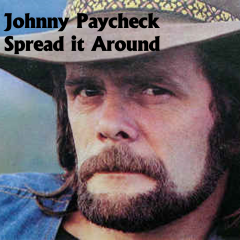
“Spread it Around” was written by Jerry Foster and Bill Rice. It appears as the second song on side one of Johnny Paycheck’s 10th studio album, Somebody Loves Me. Personnel on the album were Johnny Paycheck (vocals) and various Nashville studio musicians.
Somebody Loves Me was recorded in Nashville during the summer of 1972 and produced by Billy Sherrill. Released by Epic Records in October 1972, it went to #16 on the Billboard Country Albums chart. One single, “Somebody to Love,” was released from the LP and went to #21 on the Billboard Hot Country Singles chart.
Johnny Paycheck (Donald Eugene Lytle) was an American country music singer, songwriter and musician. He was most known for his 2 million-selling hit single version of the David Allan Coe song “Take This Job and Shove It.” He started his professional career in the late fifties as a harmony singer in Nashville with numerous country artists. George Jones gave him a break in the mid-sixties by hiring him as a bass player and harmony singer and helped him place some of the songs he had written with Jones and other artists. He started putting out records of his own after he had legally changed his name to Johnny Paycheck in 1965. After the success of Willie Nelson and Waylon Jennings in the mid-seventies, Paycheck changed his image and became part of the outlaw movement in country music. He released 30 studio albums, 20 compilation albums, and 64 singles. He was a member of the Grand Ole Opry and received an Academy of Country Music Career Achievement Award in 1977. After suffering ill health for several years, Paycheck died in Nashville in February 2003. George Jones paid for his funeral and burial plot.