Nearly 300 million COVID vaccine doses have been administered in the U.S., and normal life is returning to public places across America. Actual fans are replacing cardboard facsimiles in ballpark seats, corner pubs and corner offices are filling up, and family gatherings now feature hugs instead of half-inch squares on a Zoom screen. And another powerful antidote, in the form of higher oil prices, has spurred a significant revival in the fortunes of the pandemic-battered upstream oil and gas industry. The spring-of-2020 crude oil price crash hit the E&P sector like a tsunami, shattering capital and operating budgets, upending drilling plans, eviscerating equity valuations, and raising concerns about whether some companies could generate sufficient cash flow to keep the lights on. Remarkable belt-tightening allowed most producers to survive, and the swift rise of oil prices beginning last fall dispelled the COVID clouds. But the recovery in profitability and cash flow generation was slow. Today, we review the dramatic surge in E&P profits and cash flows in the first quarter of 2021.

Canadian crude output is rising, requiring new export routes. As traditional pathways face constraints, the U.S. Rockies—especially the Guernsey, WY hub—are emerging as key corridors for moving Canadian heavy crude to downstream markets, including the Gulf Coast.
Before we move on to the most recent quarter, let’s take a quick look back at the financial wreckage the pandemic inflicted on upstream oil and gas companies in the first half of 2020. As we discussed in our blog Spring Breakdown, the plunge in oil prices in late March of last year triggered a combined $59 billion in pre-tax operating losses for the universe of E&P companies we track, with most of the losses tied to massive price-related impairment charges. But other than those impairments, the first quarter of 2020 was pretty decent, with cash flow amounting to nearly $17 billion. Then WTI oil prices plunged 40% in the second quarter and the major producers we follow realized just $13.89 for every barrel of oil equivalent (boe) they produced, nearly 50% below the preceding quarter and the lowest realization in more than a decade. Predictably, second-quarter cash flows for the group were a scant $5.9 billion, down 70% from the previous quarter and 79% lower than the year-ago quarter. First half 2020 pre-tax losses for our universe of E&Ps totaled $83 billion. As we detailed in Coming Out of the Dark, the clouds began dissipating in the second half of the year, but cash flows climbed slowly and the E&Ps we monitor still reported a net loss for the fourth quarter of 2020.
But sunshine — in the form of oil prices that approached 2018 highs — spurred a resurgence of profitability in the first quarter of 2021 that exceeded results from the largely pre-pandemic first quarter of last year. As shown in Figure 1, our universe of 39 E&Ps earned $13.4 billion ($12.62/boe; dashed blue oval) in pre-tax income and generated nearly $25 billion ($23.51/boe; dashed green oval) in cash flow during this year’s first quarter. Every company we track posted a quarterly profit, compared with only 12 in the first quarter of 2020, when our E&P universe lost $35 billion ($31.81/boe; dashed red oval) and generated cash flow of only $17 billion ($15.26/boe, dashed yellow oval). Improved oil and gas prices and a reduction in impairment charges are the primary causes of the reversal of fortunes. In the first quarter of 2021, realized prices were $33.29/boe, compared with $25.10/boe in the year-ago quarter, resulting in a $7.3 billion increase in revenue. Lifting costs were little changed year-over-year ($9.78/boe vs. $9.84/boe). Depreciation, depletion, and amortization (DD&A) charges declined 11% to $10.16/boe, most likely because of the level of impairment charges that erased asset values in 2020. Impairment charges in the first quarter of 2020 totaled over $39 billion ($34.75/boe), compared with a mere $453 million ($0.43/boe) in this year’s January-through-March period. Exploration expenses were not a factor in either quarter. The only negative metric is the 5% decline in production to 1.06 billion boe over the past year, which reflects the impact of greatly reduced capital expenditures in 2020.
About the song
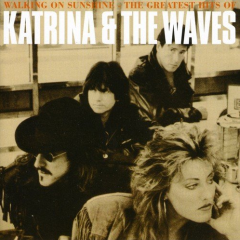
"Walking on Sunshine" was written by Kimberley Rew the lead guitarist for Katrina and the Waves, and originally appeared as the fifth song on the group’s debut album, which was released in Canada only in December 1983. The song reappeared as the sixth track on the band's first album for Capitol Records — and third studio album for the group — Katrina and the Waves. Most of the record was re-mixed versions of songs that had appeared on their first two albums; "Walking on Sunshine," and "Going Down to Liverpool" were re-recorded versions from their debut album. Released as a single in March 1985, the song went to #9 on the Billboard Hot 100 Singles chart. It has since appeared in many advertisements and movies. Personnel on the record were: Katrina Leskanich (lead vocals, rhythm guitar), Kimberley Rew (lead guitar, backing vocals), Vince de la Cruz (bass, backing vocals), and Alex Cooper (drums, percussion, synthesizer, backing vocals).
The Katrina and the Waves LP was recorded between November 1984 and January 1985 at Alaska Studios and The Greenhouse in London, with Pat Collier and Katrina and the Waves producing. Released in March 1985, the album went to #15 on the Billboard Top 200 Albums chart. Four singles were released from the LP.
Katrina and the Waves were a British new wave rock band formed in Cambridge, England, in 1982. Known for their hit, "Walking on Sunshine," they got their first album deal from Attic Records in Canada in 1983. In 1984, The Bangles had a hit with Katrina and the Waves’ song, "Going Down to Liverpool," which helped the band secure a record deal with Capitol Records in the U.S. in 1985. The band won the Eurovision Song Contest in 1997 with their song, "Love Shine a Light." They released 10 studio albums, five compilation albums, and 24 singles before breaking up in 1999.