
Rapid change in the Gulf Coast crude supply picture is encouraging new infrastructure investment by crude and feedstock terminal companies anxious to capitalize from increased throughput volumes. A 3 MMb/d influx of new crude from pipelines in Texas and the Midwest over the next two years could easily end up causing indigestion at Houston refineries and that means opportunity for storage and blending operators. Today we continue our survey of Gulf Coast crude terminals by looking at Oiltanking Houston.
Recap
In Part 1 of the series (see Echo and the Blending Men) we looked at the new 6 MMBbl Enterprise ECHO crude terminal being touted as a delivery point if the NYMEX list a Houston crude futures contract. In Part 2 (see Nederland Crude Wonderland) we looked at the Energy Transfer Partners/Sunoco Logistics Nederland Terminal at Port Neches on the Texas/Louisiana border between Beaumont and Port Arthur 100 miles East of Houston. That terminal has been in place since the beginning of the twentieth century and now has 22 MMBbl of storage capacity.
Oiltanking Houston
This time we turn our attention to the Oiltanking Houston (OTH) Terminal on the Houston Ship Channel east of downtown Houston. The Ship Channel is the conduit for ocean going vessels between the Port of Houston, Galveston Bay and the Gulf of Mexico. One of the largest refinery and petrochemical complexes in the world runs along the Ship Channel. Don’t book a vacation there. We found a satellite map of the Ship Channel that includes the names of many of the plant facilities and terminals and we have attached a copy of it at the end of the blog (scroll down to the bottom of the page – if the download doesn’t work for you, let us know at [email protected] and we will email a copy). We reproduce a smaller version of the map below with the OTH terminal marked with a black arrow. You can see that Oiltanking are right in the thick of the action.
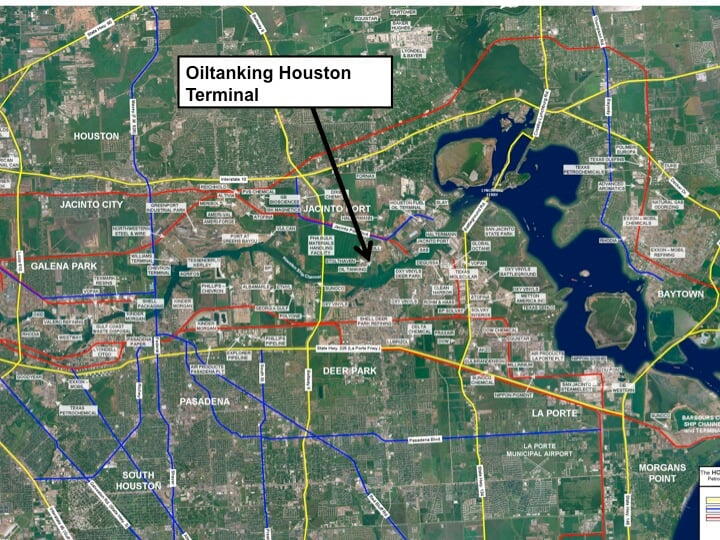
Source: Bay Area Houston Economic Partnership
OTH is operated by a public Master Limited Partnership (MLP), Oiltanking Partners, L.P. that was listed in July 2011. Oil Tanking Partners own two terminals, OTH and Oiltanking Beaumont, a refined products terminal. Goldman Sachs has a 7.5 percent minority interest in Oil Tanking Partners and the General Partner is Marquard and Bahls, AG who own the Oilltanking Group that has 72 terminals in 22 countries. We discussed MLP structures previously (see Masters of the Midstream) and OTH is an example of a large international company taking advantage of the MLP structure to optimize their US midstream assets. As we shall see, OTH is investing heavily in expanding their terminals.
Readers of this series are familiar by now with the modus operand of the terminal operator. Refiners and chemical companies use terminals because their facilities may not have adequate storage capacity or sufficient dock infrastructure. They also provide storage services to producers, marketers and traders who need access to large, strategically located storage capacity.
Terminal Facilities
OTH meet all those requirements with storage capacity at just over 12 MMBbl and a central location on the busy Houston Ship Channel. Sixty five percent of OTH’s storage is used for crude oil and 25 percent for petrochemical feedstocks. OTH define petrochemical feedstocks as naphtha and condensates (see Where is All This Condensate Going? for more on petrochemical feedstocks). The remaining 10 percent of OTH storage is used for refined products. OTH has marine access for barges and oil tankers as well as rail and truck facilities. The OTH terminal has direct pipeline connections to four refineries located in the Ship Channel (combined capacity 850 Mb/d) as well as the huge ExxonMobil Baytown refinery (560 Mb/d) to the East and three Texas City refineries to the south (combined capacity 790 Mb/d). The table below lists these refineries that have a total capacity over 2.2 MMb/d.