Natural gas prices for the nearby CME NYMEX futures contract at the Henry Hub in Louisiana have fallen by 38 percent from their high in February of $6.149/MMBtu to yesterday’s close at $3.847/MMBtu (July 24, 2014). Over the same period the price of CME NYMEX Appalachian coal has stayed virtually flat at $60/ton. So far falling gas prices have not increased power burn – the consumption of natural gas by power generators switching from coal. But natural gas prices in the Marcellus at Dominion South Point have fallen by nearly 60 percent since February to $2.46/MMBtu making natural gas a cheaper fuel than coal for power burn in that region. Today we discuss prospects for coal to gas switching this summer.
This analysis is based on comparing fuel costs for generating power using natural gas and coal. The idea is to understand when power system operators might use gas fired plants instead of coal to meet part of baseload – day in day out demand for electricity. That debate is starting to be heard among gas market analysts now because gas prices have been falling – perhaps to the point where generating power with gas becomes cheaper than using coal. Natural gas prices are falling right now in large part because US production is at record levels while demand is tepid because 2014 summer weather has been milder than normal so far. A mild summer means less natural gas is used to generate power to meet air conditioning demand. Power generation to meet peak air conditioning demand is typically met by cycling up natural gas “peaker” generation units during the day. That is not happening as much as usual this summer and the slower demand means there is a lot of spare gas out there being injected into storage. But if the price of natural gas drops to a point where it is cheaper to generate baseload power using gas than it is to burn coal, then significant fuel switching could occur. That would increase demand for gas to generate baseload power at the expense of coal. The question at hand is whether gas prices have fallen low enough that we can expect an uptick in fuel switching from gas to coal by power system operators.
We haven’t done fuel-switching analysis for a while in an RBN blog post so we’ll give you a brief explanation of the logic and the math before we get into the charts. For a more detailed explanation see the two part blog series Talking ‘Bout My Generation Part 1 and Part 2. The theory behind our analysis is called “economic dispatch” and it dictates that once certain priorities have been attended to such as system safety and reliability, the order of generation plant dispatch is governed primarily by fuel cost. Coal to gas fuel switching requires power system operators to use natural gas instead of coal when they have a choice of units to meet base power load.
To calculate fuel costs we look at generation plant economics in terms of efficiency. By this we mean how efficiently the plant converts hydrocarbons in the shape of coal or natural gas molecules into electricity. Plant efficiency is measured in btu’s (a unit of energy) per kilowatt hour (btu/kwh). In a perfect plant it would take 3412 btu to generate 1 kwh of electricity at 100 percent efficiency. That perfect plant does not exist. An average natural gas combined cycle gas turbine (CCGT) plant runs at 44.78 percent efficiency (source EIA) and an average coal plant has 33.64 percent efficiency. These efficiency rates are also known as heat rates. We translated these efficiency numbers into $/MWH by applying an efficiency factor to CME NYMEX Henry Hub, LA natural gas and CME NYMEX Appalachian coal prices. You can go back and look at the original calculation via the link to the previous blogs above but to save time here we will cut to the chase and tell you that to get our results we multiply the gas price ($/MMBtu) by 7.619 and the coal price ($/Ton) by 0.4226. Figure #1 below shows the fuel cost comparison data in $/MWH since March 2012.
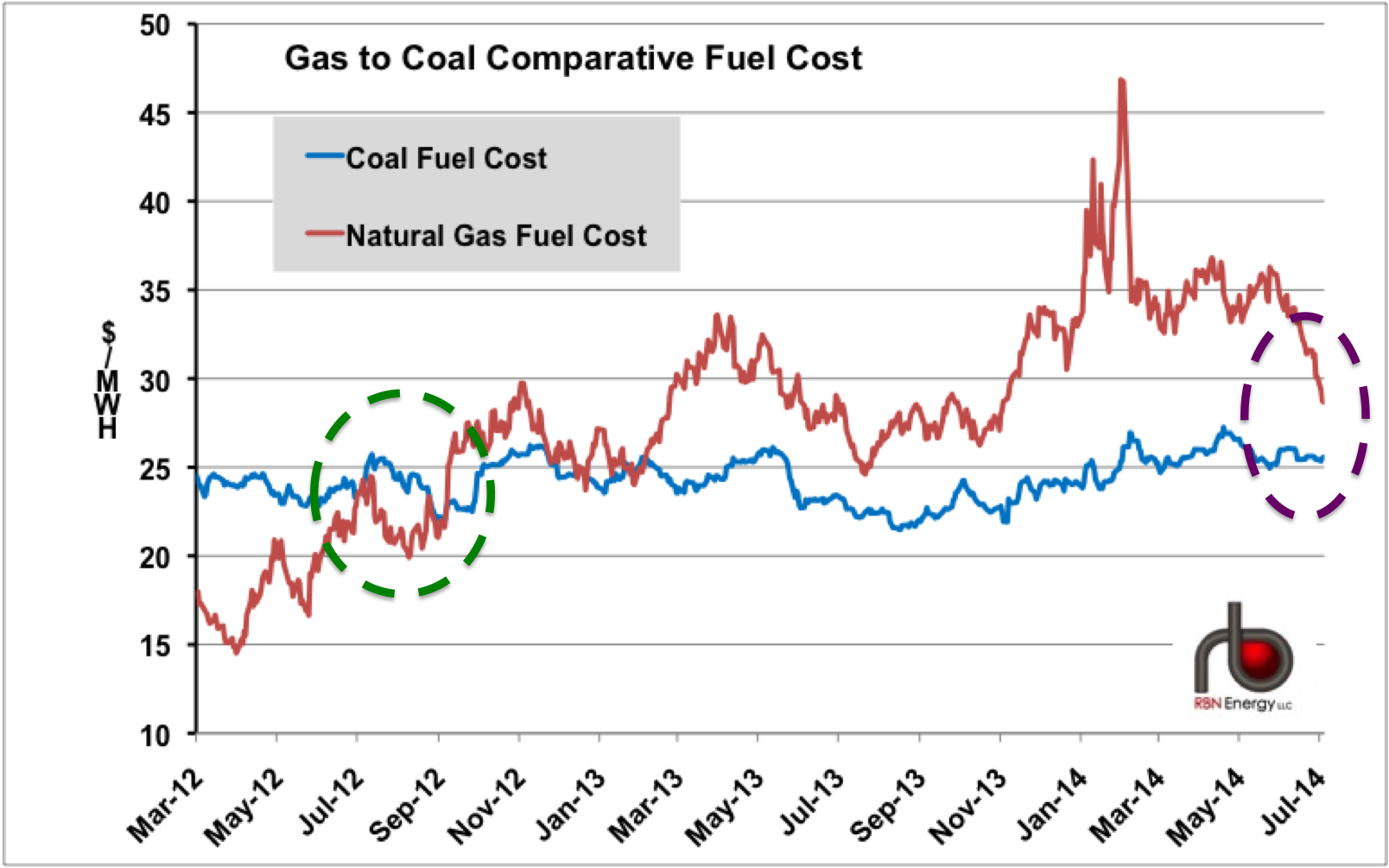
Figure #1

About the song
“Handy” Is a spoof of Iggy Azalea and Charli XCX's hit "Fancy" on the No 1 Billboard Album “Mandatory Fun” by Weird Al Yankovitch
Song title spoofs? Whatever next…