Despite last month’s much-publicized start-up of two new crude oil pipelines from the Permian Basin to the Gulf Coast — Plains All American’s Cactus II and EPIC Crude Holding’s EPIC Pipeline — tangible evidence of how much crude is actually moving on those pipelines has been hard to come by. That’s because crude oil pipelines don’t post daily flow data, like some natural gas pipelines do, and shipper volumes are a closely held secret that often only becomes available long after the fact. However, Cactus II and EPIC both deliver into the Corpus Christi, TX, market area, where a number of export facilities have been waiting to move Permian barrels out into the global market. We’ve been keeping a close eye on Corpus-area docks and have noticed a significant increase in export volumes over the last few days — a clear indication that Permian crude on Cactus II and EPIC has broken through to the global market. Today, we detail a recent rise in Corpus Christi oil export volumes driven by new supply from the Permian Basin.
The Permian Basin has been front-and-center for us lately in this space, as activity there remains robust in both the upstream and midstream energy sectors. Just a few days ago, in Higher Ground, we blogged about how new crude oil and natural gas pipelines are lifting prices for both commodities. One of the major drivers of the price gains on the crude side has been the start of Plains’ Cactus II pipeline, which we profiled recently in Takeaway. In that blog, we also detailed how Cactus II is already interconnected with many of the existing export facilities in the Corpus Christi area. Now, recent data suggests that the volumes being brought in by Cactus II and EPIC — the other new pipeline to Corpus — are starting to show up as crude oil exports. According to data from our Crude Oil Voyager report, outbound shipments of crude from Corpus hit a record last week, suggesting that the expected surge in exports of Permian oil is finally occurring.

To truly understand Cushing — what it does and how it works — you need to know the hub’s assets and how they fit together. RBN’s Cushing Crude Oil Playbook provides the first one-stop, comprehensive guide to the hub’s assets.
First, a quick recap on how Permian oil is getting to the Corpus Christi area. The map in Figure 1 shows the recently completed pipelines from the Permian to Corpus, as well as the under-construction Gray Oak Pipeline. Cactus II (green line) consists of 575 miles of new 26-inch pipeline and extends from the Permian to various delivery points in South Texas. Plains has stated that Cactus II is already complete to Ingleside — just across the bay from Corpus proper — and will be in full service to Corpus itself by the end of the first quarter of 2020. While we don’t know the capacity of Cactus II’s interim service, Plains has sold 585 Mb/d of capacity on the line, which is expandable to 670 Mb/d. The EPIC Pipeline (orange line) has also entered service and delivered its first volumes to Corpus, according to a statement from its operator, EPIC Crude Holdings. While EPIC will eventually be capable of moving 590 Mb/d out of the Permian when it’s in full service early next year, it is currently providing only 400 Mb/d of interim takeaway capacity. Finally, the Gray Oak Pipeline is expected to come online by the end of this year, adding another 900 Mb/d of capacity from the Permian to the Texas Gulf Coast. Gray Oak will make deliveries near Corpus but also extend northeast to Sweeny, TX. All told, the two pipelines in operation have added about 1 MMb/d of new capacity; that will grow to over 2 MMb/d by early next year once Gray Oak is commissioned and EPIC reaches full capacity.
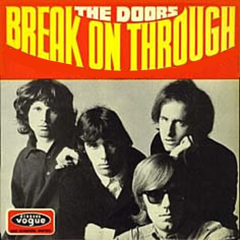
About the song
“Break on Through" was written by The Doors and released as the first single from their debut album, The Doors, in January 1967. The song features a bossa nova rhythm and heavily distorted piano bass and guitar supporting Jim Morrison's vocals. The single wasn’t an immediate hit — it only rose to #126 on the charts — but over time it became one of The Doors’ signature songs. (The group’s next single release from the album, the mega-hit "Light My Fire," would rise to #1.)
The Doors’ first album was recorded in August and September of 1966 on a four-track machine at Sunset Sound Recorders in Los Angeles. Personnel on the record were; Jim Morrison (lead vocals), Ray Manzarek (Vox Continental organ, Fender Rhodes electric piano bass), Robby Krieger (lead guitar, bass on "Soul Kitchen," "Back Door Man") and John Densmore (drums). Studio bassist Larry Knechtel played bass on "Twentieth Century Fox," "Light My Fire," "I Looked at You" and "Take It as It Comes." The LP went to #2 on the Billboard Top 200 Albums chart.
The Doors were an American rock band formed in Venice, CA, in 1965. They took their name from the title of Aldous Huxley's book, Doors of Perception, which discussed Huxley’s psychedelic experience while under the influence of mescaline in the early 1950s. Vocalist Jim Morrison, keyboardist Ray Manzarek, guitarist Robby Krieger, and drummer John Densmore cut their teeth playing the clubs in Los Angeles, and creating controversy and a large following along the way. They released nine studio albums, five live albums, 21 compilation albums, and 21 singles. They won three Grammy Awards and a Grammy Award for lifetime achievement, and were inducted into the Rock and Roll Hall of Fame in 1993. Jim Morrison died in 1971, and Ray Manzarek in 2013. Surviving members Robby Krieger and John Densmore still play live occasionally.