Cheniere Energy’s Sabine Pass LNG liquefaction and export facility in Louisiana last week received federal approval to begin operating its fourth 650-MMcf/d liquefaction train, bringing the total export capacity at the terminal to 2.6 Bcf/d. Natural gas supply delivered to the terminal for export has averaged 2.0 Bcf/d in recent months, with flows jumping as high as 2.9 Bcf/d on some days last month as the operator readied Train 4 for operations. There are several supply regions targeting this new demand, including the fastest growing producing region, the Marcellus/Utica Shale in the U.S. Northeast. While there isn’t yet a direct beeline from the Marcellus/Utica to Sabine Pass, there are early indications that recent pipeline takeaway and reversal projects from the producing region and the resulting connectivity are indirectly bridging the divide. In today’s blog, we examine pipeline flow data to understand recent changes in flows and what they can tell us about future flow patterns as export demand continues to grow.
LNG export demand from Cheniere’s Sabine Pass terminal — the first and, for a little while longer, the only export facility in the contiguous U.S. — has been growing like gangbusters over the past two years. The facility has quickly increased from its first 650-MMcf/d operational liquefaction train starting in early 2016 to now four trains as of last week, in less than two years. The fourth train loaded its first commissioning cargo in August 2017 and just last week received federal approval to begin liquefaction and export activities.
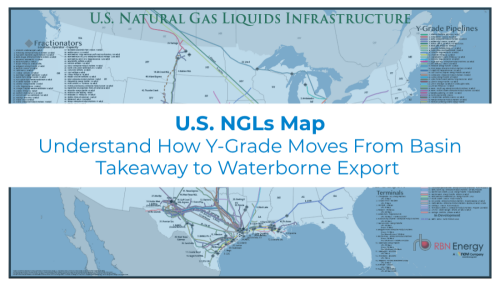
Visualize the infrastructure behind U.S. NGL movement.
The U.S. NGLs Map provides a comprehensive view of the transport, processing, and export networks moving NGLs across the U.S.
From here on out the construction schedule is expected to slow, with Train 5 not due for completion until August 2019. But emerging export capacity along with the pipeline expansions targeting it already have reconfigured gas flow patterns in the Eastern U.S. One of the biggest and fastest growing beneficiaries of the new demand is expected to be Marcellus/Utica producers. It lies more than 1,000 miles north of Sabine Pass and is connected to the Gulf Coast by pipelines that historically have moved gas north from Texas and the Gulf Coast. But recent developments, including a combination of Marcellus/Utica takeaway pipeline expansions and reversal projects are increasingly connecting the markets.
Tallgrass Energy has added 2.6 Bcf/d of takeaway capacity west out of Ohio on its highly interconnected, cross-country Rockies Express Pipeline (REX) over the past few years (see It’s Been a Long Time Comin’). Energy Transfer Partners (ETP) began operating its new Ohio-to-Midwest Rover Pipeline just last month (see Against All Odds). Both of these pipes cut east and west across numerous legacy north-south long-haul pipelines, like TransCanada’s ANR Pipeline and Columbia Gulf Transmission (CGT), Boardwalk Partners’ Texas Gas Transmission (TGT), ETP’s Panhandle Eastern and Trunkline pipelines, which have been working to reverse northbound capacity with backhaul projects of their own. Closer to the terminal, Williams’ Transco earlier this year put into service its Gulf Trace project, which made flows bidirectional in its Zone 3 segment, from the Texas-Louisiana border to the Louisiana-Mississippi border. So, how can Northeast supply currently get to Sabine Pass? Next, we dive into pipeline flow data from our friends at Genscape to understand those dynamics.
About the song
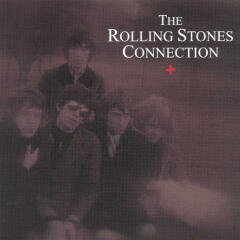
“Connection” was written by Mick Jagger and Keith Richards and appears as the fourth song on side one of The Rolling Stones’ seventh American studio album, Between the Buttons. The song seems to portray the time that The Rolling Stones spent waiting on planes at various airports while touring. On closer inspection of the lyrics, it seems to foreshadow the drug busts that Richards, Jagger and Brian Jones experienced in Great Britain in 1967. “My bags they get a very close inspection. I wonder why it is that they suspect ’em. They’re dying to add me to their collection. And I don’t know if they'll let me go.” Norman Pilcher, the arresting officer in the Richards, Jagger, Jones, Donovan, John Lennon and George Harrison cases on similar cannabis possession charges, was later convicted himself in September 1973 of perjury and sentenced to four years in prison. The line “simolima pilchard” in the lyrics of The Beatles’ “I am the Walrus” refers to the ex-sergeant, as does the 2003 Primus song, “Pilcher’s Squad.” The thumping kick drum heard on “Connection” was supplied by Jagger, who beat on Charlie Watts’s kick drum with his hands during an overdub. Personnel on the record were: Mick Jagger (harmony vocal, tambourine, kick drum), Keith Richards (lead vocal, guitars, bass), Charlie Watts (snare drum), and Jack Nitzsche (piano, organ bass pedals).
Between the Buttons was recorded between August and December 1966 at RCA Studios in Hollywood and Olympic and Pye Studios in London, with Andrew Loog Oldham producing. Released in February 1967 in the US, it went to #2 on the Billboard 200 Albums chart. It has been certified Gold by the Recording Industry Association of America. The album featured Brian Jones using an assortment of different instruments, including a recorder, vibraphone, saxophone, accordion, and dulcimer. It would be the last Rolling Stones album produced by Loog Oldham. One single was released from the LP.
The Rolling Stones are a British rock band formed in London in 1962 by Mick Jagger, Keith Richards, Brian Jones, Bill Wyman, and Charlie Watts. Jones left the band in 1969 and was replaced by Mick Taylor. Taylor was replaced by Ronnie Wood in 1974. Bill Wyman left the band in 1993 and has been replaced by Darryl Jones on tour. Charlie Watts died in 2021 and has been replaced by Steve Jordan on tour. They have released 30 studio albums, 35 live albums, 29 compilation albums, three EPs, and 121 singles and have sold more than 200 million records worldwide. The Rolling Stones have won three Grammy Awards and a Grammy Lifetime Achievement Award, and are members of the Rock and Roll Hall of Fame and the UK Music Hall of Fame. In 2003 Mick Jagger was knighted by Queen Elizabeth II for his services to popular music. The Rolling Stones continue to record and tour.